
The customizable coding terminal.





MendCode is a terminal-first coding-agent harness you can make your own: a
public mendcode CLI, configurable model roles, review gates, Changes Review,
Memory Center, Plan Mode Markdown, Agent View, reusable team packages, project MCP config,
mflow/worktree coordination, Usage Insights, release/security gates, and a
customizable TUI for home identity, prompt chrome, widgets, panels, dialogs, and
themes without patching runtime internals. Local agents can also control the
same session runtime through versioned JSON commands for progress, waiting, and
cancellation.
Website · Docs · Feature map · Acknowledgements
- Why It Exists
- Install
- First Run
- Product Surfaces
- Documentation Map
- Development
- Community And Security
- For Agents
- Lineage
Most coding agents give you a chat box. MendCode gives you the harness around it:
| Need | MendCode surface |
|---|---|
| Make the terminal feel like your workflow | TUI profiles for prompt chrome, marker, status row, home identity, split home, Agent View, chat presentation, widgets, routes, dialogs, and themes. |
| Share a tuned setup with a team | Runtime packages for commands, agents, modes, skills, prompts, MCP config, plugins, TUI profile, model roles, permissions, memory defaults, and worktree policy. |
| Review before implementation | Plan Mode renders Markdown, including Mermaid when supported, inside a TUI review modal before switching to the implementation agent. |
| Review current code changes | /changes opens a responsive TUI diff workspace with comments and agent-visible review context between model turns. |
| Keep repeat work moving | Loop Workflows create durable, monitorable loop sessions with contract-aware report-only wakeups, /loop creation, /loops supervision, and optional per-project OS services. |
| Keep risky actions explicit | Permission modes, smart permission review, preview-first worktree actions, and approval-gated memory proposals. |
| Route work to the right model | Model roles for planning, building, explicit review agents, subagents, summaries, compaction, memory extraction, Dream, memory side chat, and permission review. |
| Let local agents drive real sessions | mendcode session and mendcode run --format json expose the existing runtime for machine-readable session control, events, waiting, inspection, and cancellation. |
| Coordinate parallel terminal work | Optional mflow locks plus optional TSM/worktree orchestration for multi-session work. |
| See local activity without cloud analytics | Usage Insights for tokens, sessions, AI time, prompt volume, changed files, top tools, top agents, top models, cache mix, daily activity, and selected-day details. |
The short version: MendCode is not just "run a model in a terminal." It is a configurable coding terminal with packaging, review, memory, permissions, and coordination built into the workflow.
Choose the row for your shell:
| Platform | Command |
|---|---|
| macOS / Linux | curl -fsSL https://raw.githubusercontent.com/MendCode/MendCode/main/src/mendcode/install | bash && mendcode |
| Windows PowerShell | irm https://raw.githubusercontent.com/MendCode/MendCode/main/src/mendcode/install.ps1 | iex; mendcode |
| Windows CMD (no PowerShell) | curl.exe -fsSL https://raw.githubusercontent.com/MendCode/MendCode/main/src/mendcode/install.cmd -o "%TEMP%\mendcode-install.cmd" && call "%TEMP%\mendcode-install.cmd" |
| Windows direct ZIP | Download the x64 ZIP and run mendcode.exe after extracting. |
| Windows Git Bash / MSYS2 / Cygwin / WSL | curl -fsSL https://raw.githubusercontent.com/MendCode/MendCode/main/src/mendcode/install | bash && mendcode |
| Pin a release | curl -fsSL https://raw.githubusercontent.com/MendCode/MendCode/main/src/mendcode/install | bash -s -- --version <version> |
| No shell startup edits | curl -fsSL https://raw.githubusercontent.com/MendCode/MendCode/main/src/mendcode/install | bash -s -- --no-modify-path && ~/.mendcode/bin/mendcode |
The public command is mendcode. Development checkouts may contain a local
mend shim for legacy/internal workflows, but public docs, examples, and
screenshots should use mendcode.
After installation, open MendCode in your repo:
mendcodeOn first launch, MendCode opens the setup screen. Use it to configure the harness once: provider/auth, model roles, budget posture, package state, TUI profile, prompt mode, memory, and permissions. Once setup is complete, use the commands below for everyday work:
Useful commands after setup:
| Command | Use it when |
|---|---|
mendcode run "review this repo and draft a plan" |
You want to open MendCode with an initial task ready. |
mendcode chat "summarize current status" |
You want a quick control-plane turn without entering the full TUI. |
mendcode session list --format json |
Another local agent needs to discover and control MendCode sessions. |
mendcode status / mendcode doctor |
You want readiness or diagnostics. |
mendcode setup status |
You want to inspect setup state after the guided setup screen. |
mendcode marketplace status |
You want to inspect active team/runtime marketplace packages. |
mendcode install <pack-id> |
You want the short marketplace install path for a package. |
mendcode mflow status |
You are coordinating multiple agents around the same repo. |
mendcode --worktree feature-branch |
You want to open MendCode against a branch/path/id worktree target. |
mendcode --tsm feature-branch |
You want a TSM workspace with a MendCode split. |
MendCode turns the terminal into a configurable product surface: home identity, prompt frame, prompt marker, status row, split panels, Agent View, action menus, chat presentation, widgets, slots, custom routes, dialogs, footer entries, and themes.
| Choose the home identity | |
Option A: wordmark welcome
|
Option B: mascot welcome
|


| Choose the working layout | |
Option A: wordmark with Agent View
|
Option B: mascot with Agent View
|


| Choose the action surface | |
Option A: wordmark actions
|
Option B: mascot actions
|


| Configure the terminal profile | |
Example profile JSON |
Command palette entries |
| Agent View as a first-class terminal surface | |
Full Agent View
|
What can be themedHome layout, title identity, mascot mode, prompt frame, prompt lead, status placement, chat presentation, activity states, widgets, slots, custom routes, dialogs, footer entries, and theme tokens. |

A MendCode marketplace package captures the reusable parts of a team setup:
.mendcode/
  agents/
  commands/
  modes/
  skills/
  prompts/
  plugins/
  tools/
  pages/
  tui/
  widgets/
Packages can include MCP config, context docs, scripts, TUI profiles, theme tokens, custom tool calls, custom TUI pages, shell-backed widgets, model roles, focus defaults, budget posture, permission defaults, memory defaults, and worktree policy.
Packages must not include provider tokens, OAuth state, .env*,
.mendcode/auth, local databases, room secrets, or machine-local cache/run
state.
mendcode marketplace create --id acme-standard --title "Acme Standard" --include skills,modes,plugins,tools,pages
mendcode marketplace list
mendcode install acme-standard
mendcode marketplace install acme-standard
mendcode marketplace enable acme-standard
Plan Mode is for users who want the agent to think first without silently editing files.


- The planning agent researches and writes a Markdown plan.
- MendCode renders the plan in a TUI modal.
- The user can approve, edit, comment, reject, or close.
- Approval switches into the configured implementation agent.
- The reviewed Markdown becomes the source of truth for implementation.
See Plan Mode.
Changes Review opens the current working-tree diff inside the TUI. It is a
review workspace, not just static patch text: move by file, hunk, or line; add
comments; reload the diff; then press Esc or q to return to chat without
stopping the active session.

/changes
When the view is active, MendCode gives the assistant bounded review context on model turns: selected file/hunk/line, comments, stale comment count, and compact file summaries. Comments added while an agent is working become visible to the agent on the next model turn, including after a tool call completes. MendCode does not splice new comments into an already-running token stream.
See Changes Review.
Loop Workflows are durable, monitorable loop sessions for objectives that should
keep moving across controlled iterations. A loop starts from /loop, is
supervised in /loops, becomes an activated root session, records run/journal
events, appears in Agent View, and can be woken manually or by a per-project
background service.


mendcode loops examples
mendcode loops draft --template research-digest --name "Loop test"
mendcode loops activate loop_...
mendcode loops tick loop_... --execute --report-only
mendcode loops monitor loop_...
For a workflow whose durable contract is already report-only/read-only,
--execute --report-only wakes the agent and writes transcript activity without
edit/write/patch/shell/subagent tools. Edit-capable workflows keep their
contract; full execution remains explicit through --execute or
mendcode loops service start --allow-edits.
See Loop Workflows.
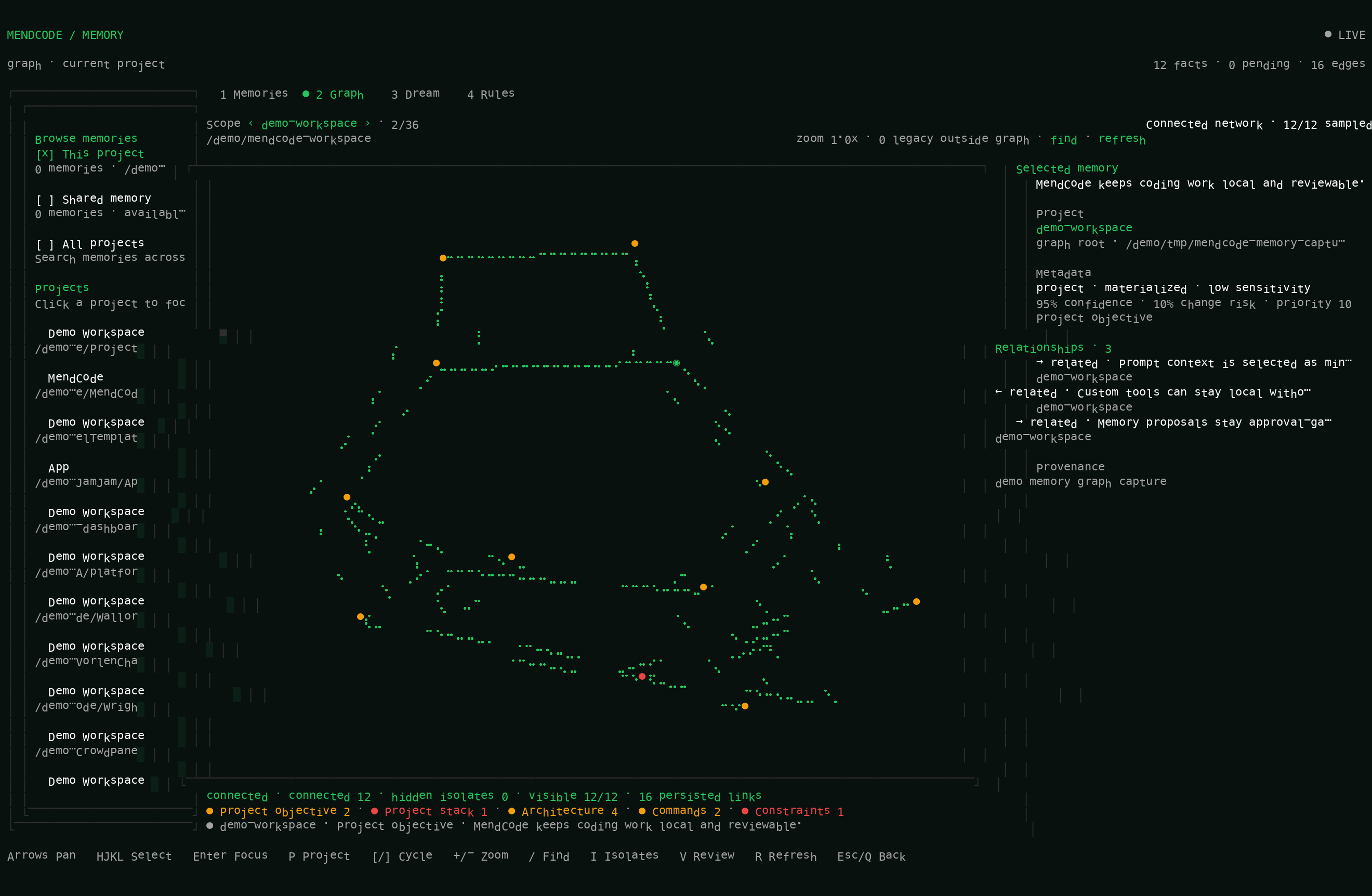
MendCode memory is approval-first by design. It can retrieve useful project context without turning every session into permanent state.
- global and project scopes
- explicit
mendcode memory add mendcode memory searchandmendcode memory preview- generated memory proposals
- apply, reject, and edit proposal flow
- transient prompt injection through bounded memory context
The Memory Center view brings saved memories, pending proposals, categories, Dream state, project grouping, and a constrained memory side chat into one reviewable workspace. See Memory Center.
Usage Insights is local observability for the coding harness, not cloud analytics and not a productivity claim.

It can show global/project/directory scope, token heatmaps, sessions, active days, prompt volume, AI generation time, tool runtime, changed files, top tools, top agents, top models, cache mix, and optional weather.
See Usage Insights.
MendCode includes optional coordination for people running multiple terminal sessions around the same codebase.
| Surface | Purpose |
|---|---|
| mflow | Local-first coordination, room activation, daemon status, and edit locks. |
| Worktrees | Preview-first creation, adoption, opening, reset, and removal of git worktrees. |
| TSM | Optional terminal-session workspace setup for MendCode panes. |
mendcode mflow setup
mendcode worktree plan feature-branch
mendcode worktree create feature-branch
mendcode tsm setup| If you want to... | Read |
|---|---|
| Understand the whole product surface | Feature map |
| Install, configure, and check readiness | CLI, setup, and configuration |
| Shape the visual terminal experience | Customization |
| Share marketplace packages | Marketplace and team sharing |
| Let another agent control sessions | Automation runtime |
| Extend the TUI with code | TUI plugins and widgets |
| Use plan review gates | Plan Mode |
| Review working-tree changes | Changes Review |
| Run durable agent loops | Loop Workflows |
| Inspect local activity | Usage Insights |
| Coordinate multi-session work | mflow, TSM and worktrees |
| Understand source layout and ownership | Architecture |
| Release safely | Releasing, Supply chain security |
This repository contains the MendCode-owned runtime under src/mendcode/.
Focused development usually happens in src/mendcode/packages/opencode.
Useful commands from an existing checkout:
cd src/mendcode/packages/opencode
bun test --timeout 30000
bun run typecheck
bun run build
The root src/mendcode package intentionally does not use bun test as the
normal test entrypoint; run focused tests from the package that owns the change.
- Contributing: local development, PR expectations, and review flow.
- Security policy: supported reporting path for security issues.
- Community docs: issues, discussions, labels, and contribution guidance.
- Release process: release assets, checksums, installer smoke tests, and public promotion.
- Supply chain security: provenance, dependency review, scanners, and release hardening.
If you are an agent working in this repository, use this short path first:
- Read the source-level contributor contract.
- Use the public
mendcodeCLI and verify live source before documenting behavior. - Run focused checks from the package that owns the change; do not run tests from the repository root.
- Keep changes minimal and never include provider tokens, auth state, or local runtime data in packages, screenshots, or docs.
Open the full MendCode repo context for coding agents
This block is intentionally collapsed so the README stays readable while still giving coding agents MendCode context before editing docs, website copy, CLI help, screenshots, or public claims. Treat it as context, then verify live code before changing behavior.
- Product name: MendCode.
- Public command:
mendcode. - Local development checkouts may include a legacy
mendshim. Public docs, examples, screenshots, release notes, website copy, and user-facing commands should usemendcodeunless the router contract changes. - MendCode is a downstream project built on opencode, with attribution in ACKNOWLEDGEMENTS.md. Do not present it as a simple rename.
- Source of truth:
src/mendcode/packages/opencode/src/mend/cli/public-bin.ts. - Re-run public help before adding command examples.
- Primary public surfaces include opening the TUI,
run,session,chat,status,doctor,setup,marketplace,mflow,worktree, andtsm. - Automation details live in docs/automation-runtime.md:
mendcode.cli.v1JSON envelopes, session lifecycle commands, progress events, bounded waiting, cancellation, secret redaction, and shared model/agent selection. It is a wrapper over the existing runtime, not a second provider or session implementation. - Support surfaces include
models,providers,auth,permissions,memory, andfocus. - Internal debug surfaces such as
adapter,ai,bench,budget,config,context,export,mcp,prompt,prompts,runtime,toolchain,tui, andupstreamshould not be marketed as normal user workflows.
- MendCode is the customizable coding terminal: CLI, TUI, setup flow, model roles, permission policy, memory, runtime marketplace packages, Plan Mode, Usage Insights, optional mflow coordination, optional TSM and worktree orchestration, widgets, plugins, and TUI profiles.
- The pitch is not another chat prompt. The pitch is a configurable harness: prompt chrome, status rows, model roles, memory policy, marketplace packages, workflow coordination, review gates, and local observability.
When an agent needs to explain what MendCode is to a reader, start with this accurate description:
This inventory was checked against the 20 latest changelog entries, 0.1.9
through 0.1.28. Use the changelog for release-specific fixes; keep this block
focused on stable product capabilities and agent-facing contracts.
MendCode is a terminal-first AI coding terminal and developer harness. It gives a local agent a configurable CLI/TUI, model roles, review gates, permissions, memory, reusable team packages, session automation, and optional multi-agent/worktree coordination.
Classify follow-up details by the product surface they change, and use the linked documentation as the source for details:
| Category | Explain it as | Primary references |
|---|---|---|
| Core terminal | The public mendcode CLI, TUI, setup/onboarding flow, provider/package setup, diagnostics, and session runtime. |
Feature map, CLI and setup |
| Prompt and model control | Prompt Context modes (minimal, focus, full, and project/package custom), .mendcode/prompts/custom.md, mendcode prompt inspection/build commands, model roles and variants, prompt status, provider-aware context continuity, image-aware compaction, and cost-aware routing. |
Feature map, CLI and setup |
| Workflow and review | Plan Mode, Changes Review, and durable Loop Workflows with validated plans, gates, schedules, receipts, artifacts, evaluators, and recovery. | Plan Mode, Changes Review, Loop Workflows |
| Media generation | The provider-aware image_gen tool, configured independently from the active chat model, with persisted artifacts, optional captions, and safe edit inputs when the provider contract and permissions allow. |
Changelog |
| Control and safety | Model roles, smart permissions, budgets, approval-first Memory Center, Memory Graph, and Dream flows, local provider bridges, and explicit destructive-action gates. | CLI and setup, Memory Center, TSM and worktrees |
| Team and extensibility | Runtime packages, project MCP configuration, package-shared prompts/custom tool calls, TUI profiles, plugins, widgets, pages, and themes. | Packages and team sharing, Custom Tool Calls, TUI plugins and widgets |
| Agent and background execution | Agent View, subagents, detached background tasks, queued prompts, reconnect/compaction recovery, and Herdr state reporting. | Automation runtime, Loop Workflows, Feature map |
| Coordination and operations | Optional mflow locks, TSM/worktree orchestration, automation commands, local Usage Insights, update discovery, and in-app upgrades. | mflow, TSM and worktrees, Automation runtime, Usage Insights |
The implementation source is src/mendcode/packages/opencode/src/tool/image-gen.ts.
Agents must keep these rules intact:
image_genis independently configured throughimage_generation; it is not inferred from the active chat model. Configuration supportsenabled, aprovider/modelreference,adapter(auto,codex-oauth,openrouter, oropenai-compatible),base_url, timeout, provider options, and optional captions.enabled: falsemust hide the tool.- With an active OpenAI ChatGPT subscription OAuth login and no explicit image
model, the verified Codex adapter defaults to
openai/gpt-image-2. API-key sessions do not receive that OAuth fallback automatically. Auto adapter selection is limited to verified provider contracts; unknown image-capable providers require an explicit adapter. - Use it only for an explicit request to create or edit a bitmap image. Include
orientation, aspect ratio, target resolution, exact text, visual constraints,
and avoid-items in the prompt. For a new image, omit both reference fields
(
num_last_images_to_include: 0is also valid). For edits, provide either up to five absolute local image paths or one to five recent conversation images, never both. - The
image_genpermission is checked before the request; referenced local images also require read permission and must stay within the allowed project boundaries. Enforce the 50 MB input/output bounds, request timeout, safe image URLs, and cancellation. - Generated artifacts are persisted under MendCode's managed
generated_imagesdirectory and returned with metadata, format, dimensions, size, provider, adapter, model, path, and cost when available. The full TUI shows the saved path and external-open actions instead of rendering the image inline. - Captions are optional and use an independently configured vision model. A missing or failed optional caption must not discard the saved artifact; a required caption may fail the tool after the artifact has been persisted.
- For project-bound work, copy the selected artifact into the workspace with a stable descriptive filename and never overwrite an existing asset unless the user explicitly requests replacement. Do not expose tokens, auth state, or sensitive source images in prompts, captions, artifacts, or docs.
- Activate a Loop Workflow or delegate background work only when the user asks
for it or the request clearly includes that intent. Inspect existing loops
before creating another one; never use
maxTurns: 0or recreate an invalidcompleted 0/0workflow. - Use report-only/read-only execution for inspection and monitoring. An explicit request to write, edit, fix, implement, code, or create files permits normal execution for that workflow; keep destructive worktree actions preview-first.
- Route work through the configured model roles and variants with cost-aware, provider-neutral language. Do not present internal debug surfaces as normal user workflows.
- Treat
memoryAssistantas a constrained memory-stewardship agent and Dream as a proposal-producing maintenance loop, not as silent source editing or a general coding agent. Generated memory changes remain reviewable proposals until the user applies them. - Treat
image_genavailability as provider- and permission-gated. It is an independently configured media tool, not an assumption about the active chat model; preserve artifacts and redact sensitive inputs.
The short explanation is not “another chat box” or a cloud analytics product. It is a local-first control surface for shaping how coding agents work.
- Use the feature map as the source contract for README, website, screenshot, and demo claims.
- README screenshots live in
docs/assets/screenshots/. Website copies live in the MendCode-Web repository underpublic/screenshots/andpublic/tui-showcase/. - There is currently no checked-in capture script or
mendcode screenshotcommand. Existing images are committed static assets; do not describe an automated or canonical capture flow unless one is added and verified. - For future captures, validate the public
mendcodebehavior first, use a clean demo state, redact provider tokens/auth state/local runtime data, and update the image alt text or caption with the exact product surface shown.
- Main user-facing docs: Customization and TUI plugins and widgets.
- Profile path:
.mendcode/tui/profile.json. - Key surfaces: prompt frame, prompt lead string, prompt status row, home title, mascot mode, centered home, split home, Agent View, chat presentation, activity states, widgets, slots, custom routes, dialogs, footer entries, themes, density, and package-distributed UI behavior.
- Chat presentation includes Plain/Markdown/Rich rendering, streaming Markdown, wrapped tables and code fences, checklists, callouts, local Mermaid diagrams, and terminal-safe color swatches.
- Good demo profile: mascot identity, split home,
agentManagerright panel,top-bottomprompt chrome,mendcode>lead text, and outside prompt status.
- Main docs: Marketplace and team sharing.
- Marketplace packages can include commands, agents, modes, skills, prompts, MCP config, context docs, scripts, plugins, widgets, components, custom tools, custom pages, TUI profile, themes, model roles, focus defaults, budget posture, permission defaults, memory defaults, and worktree policy.
- Packages must not include provider tokens, OAuth state,
.env*, auth state, local databases, room secrets, or machine-local run/cache state.
- Custom tool calls are assistant-facing project or package actions loaded from
.mendcode/tools(the singular.mendcode/toolpath is also supported). They are local TypeScript/JavaScript code with a description and validated argument schema; they are not MCP tools. execute(args, context)receives the currentsessionID,messageID,agent,directory,worktree, cancellation viaabort, visible-call updates throughmetadata(), and permission requests throughask().tool.schemadefines the validation and JSON schema exposed to the model. Tools may return concise output plus metadata, and should honor cancellation and avoid silent writes outside the current project/worktree.- Packages share tools through an
artifacts.toolsmanifest entry or a project-local.mendcode/package.json. Custom tools are trusted local code: review them before enabling a package and never distribute credentials,.env*, auth state, or machine-local data.
- Plan Mode is an explicit review gate before implementation.
- Memory is approval-first: global/project scopes, explicit add/search/preview flows, generated proposals, and apply/reject/edit review.
- Memory Center is the user-facing memory workspace: saved global/project memories, pending proposals, project grouping, the Memory Graph/category graph, category policy, Dream status/logs, inspector, and constrained memory side chat.
- The memory side agent can answer memory-specific questions, inspect saved entries/categories/policies, explain why context is being retrieved, and draft reviewable proposals for memory/category/policy changes. It should be described as powerful for memory stewardship, not as a general coding agent.
- Dream is the manual/scheduled memory maintenance loop. It can consolidate
stale or duplicated knowledge, surface conflicts, generate safety evidence,
and create proposals through the
memoryDreamrole; it should not be claimed to edit source files, mutate git, or apply memory silently. - Generated memory mutations remain proposals unless the user explicitly applies them. This applies to extraction, side chat, and Dream.
- Usage Insights is local observability, not cloud analytics and not a productivity guarantee.
- Smart permissions can route risky actions through a configured reviewer role.
- mflow is optional local-first coordination and lock/status support.
- Worktree and TSM flows are optional terminal/worktree orchestration.
- Destructive worktree actions should stay preview-first and gated.
- Feature map: product inventory for README, website, screenshots, and demos.
- Docs index: user journey index.
- CLI, setup, and configuration: setup, config, models, permissions, and memory.
- Customization: static TUI profile and visual customization.
- TUI plugins and widgets: dynamic TUI extension points.
- Custom Tool Calls: project/package assistant tools, typed arguments, execution context, metadata, cancellation, and permission checks.
- Plan Mode: plan review flow.
- Changes Review: responsive diff review, comments, keybinds, and agent-visible review context.
- Loop Workflows: durable loop sessions, root
session/evaluator boundaries,
/loop,/loops, and service controls. - Automation runtime: machine-readable session control, progress events, waiting, cancellation, and shared model selection.
- Memory Center: saved/pending memories, categories, Dream maintenance, and the constrained memory side agent.
- Usage Insights: local activity dashboard.
- mflow: local-first coordination.
- TSM and worktrees: terminal/worktree orchestration.
- Architecture: source layout and ownership boundaries.
- Releasing and Supply chain security: release and supply chain policy.
- Keep docs provider-neutral unless a user explicitly asks for provider-specific examples.
- Avoid aspirational feature claims without a source path, validated behavior, or clearly marked local work.
- Prefer factual capability wording over behavioral prompt instructions.
- If code contradicts this block, the code wins.
MendCode is a downstream project built on the opencode codebase. It is not
presented as a simple fork: MendCode adds its own mendcode CLI surface,
control plane, setup flow, package system, mflow coordination, optional
TSM/worktree orchestration, Plan Mode review flow, Usage Insights dashboard,
memory policy, model-role projection, and terminal UI customization layer.
See ACKNOWLEDGEMENTS.md for attribution.

