Use your ChatGPT / Codex subscription directly in DeepSeek Harness
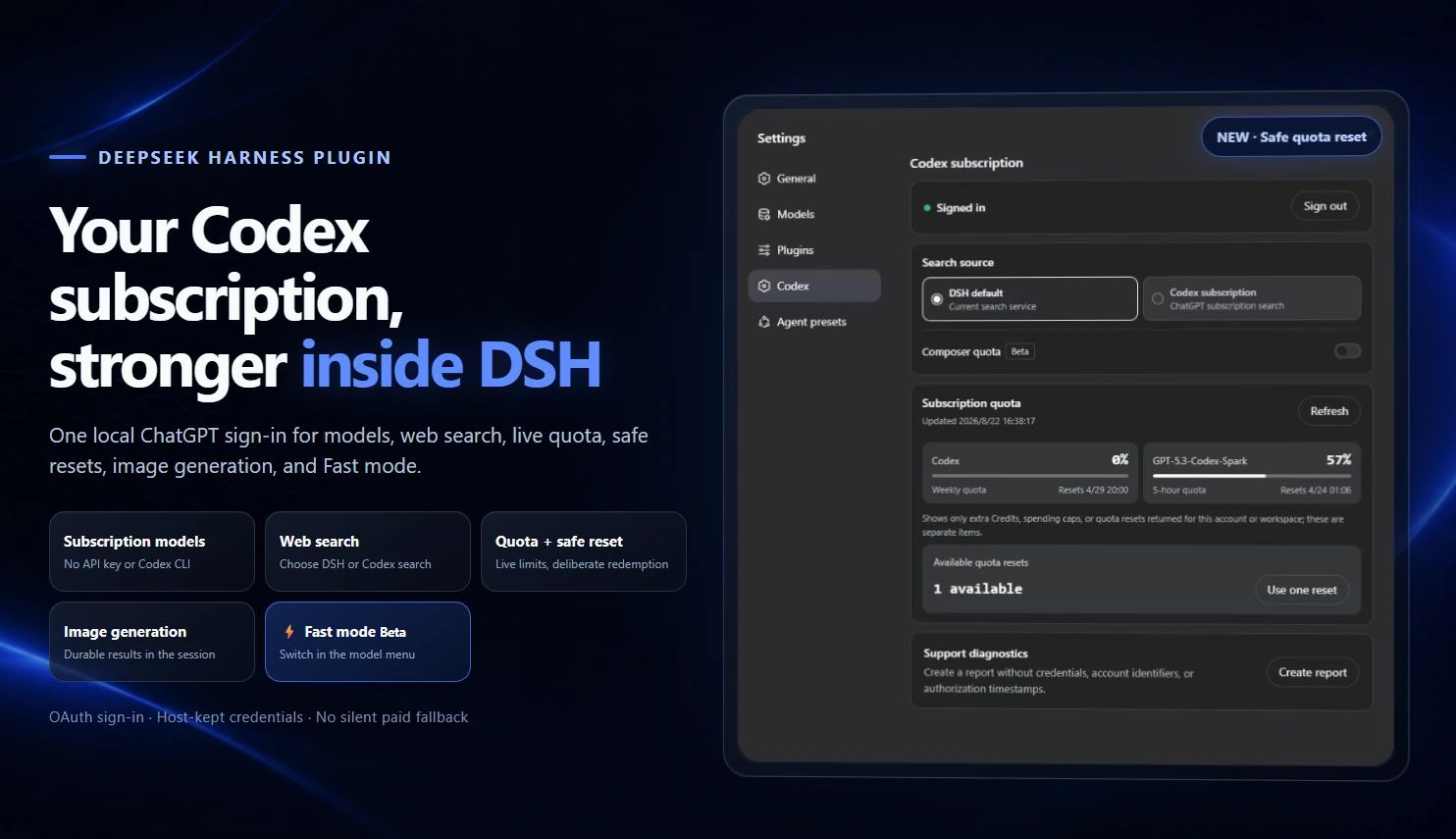
No OpenAI API key or Codex CLI. Models, search, quota, and image generation stay inside DSH.





Three-step start · Agent install · Update and uninstall · 简体中文
-
Install the plugin. On Windows, open PowerShell and run the line below. Existing
dshand DSH-Portable users can use the standard command that follows.irm 'https://github.com/WSL043/dsh-codex-subscription/releases/latest/download/dsh-codex-setup.ps1' | iex
-
Sign in. Restart DSH yourself, open Settings -> Codex, and choose browser sign-in. No Codex CLI and no pasted token are required.
-
Use Codex. Select a Codex model. Quota, subscription search, image generation, and Fast mode remain inside DSH.
With an existing dsh command, install with:
dsh plugin --profile web add dsh-codex-subscriptionDSH-Portable exposes the same standard plugin command, so the command above also applies there. See below for the complete official npm, Agent, update, and uninstall routes.
| Capability | What you get |
|---|---|
| Subscription models | Sign in to ChatGPT and use Codex without an OpenAI API key or Codex CLI |
| Recoverable and diagnosable | Sign-in state reconciles automatically; Settings can create a support report without credentials or account identifiers |
| Visible quota | Keep backend-provided standard Codex, Spark, and other limits separate |
| Composer quota | Choose a compact percentage, progress bar, or no inline quota display |
| Safe quota reset | See the next expiry and deliberately try a reset with a cooldown and acknowledgement |
| Subscription search | Explicitly choose DSH default search or Codex subscription search |
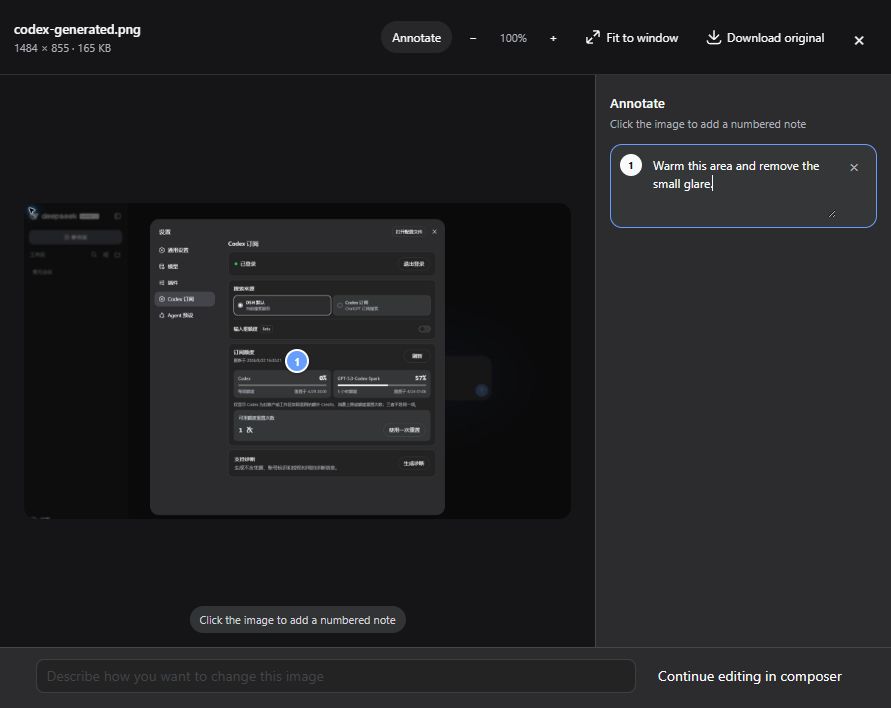
| Codex image generation and editing (Beta) | Generate without references, or explicitly edit one selected image; preview, zoom, annotate regions, download the original, and continue in the same composer |
| Fast mode | Switch between Standard and Fast directly in the composer |
| Model-aware context | Keep catalog defaults, use each model's supported extended window, or enter a full numeric token limit for each model |
These capabilities reuse the same local ChatGPT sign-in. Subscription routing failures stay visible and never silently switch to another paid route.
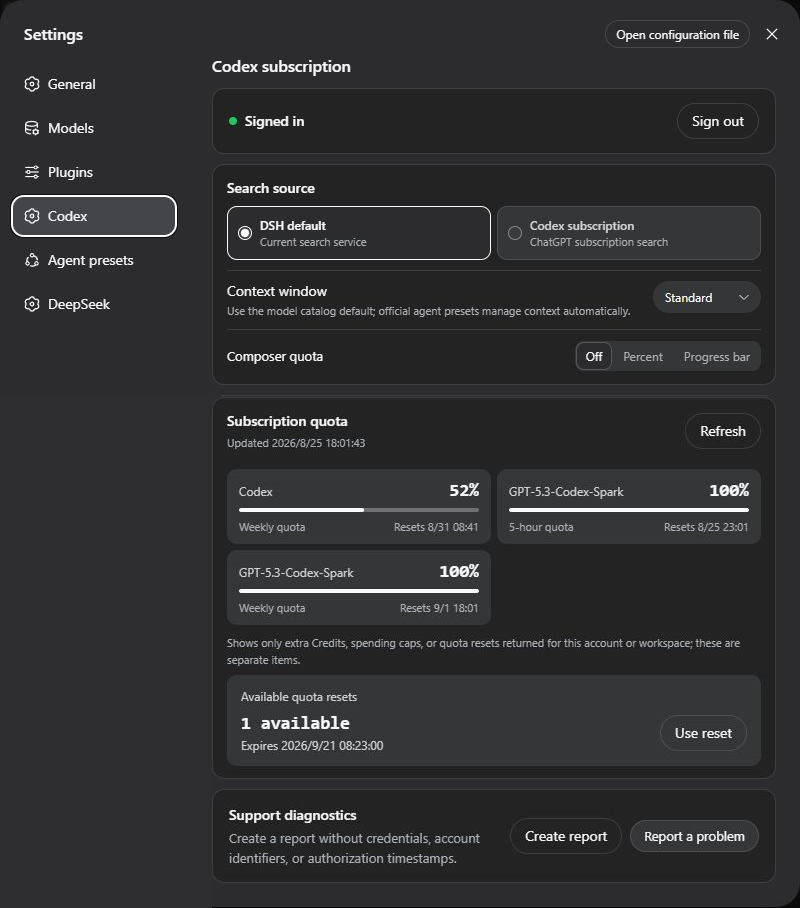
Captured from the installed official DeepSeek Harness 0.1.1-rc.2 product with the current plugin build.
This plugin is currently compatible through DeepSeek Harness 0.1.1-rc.2 and requires a ChatGPT account that currently has Codex access.
- Do not want to configure Node.js? Use DSH-Portable, a community desktop distribution with portable and installed editions for Windows plus desktop packages for macOS and Linux.
- Prefer the official route? Follow the DeepSeek Harness run guide.
Send this link directly to your Agent:
Agent install, update, and uninstall guide
https://raw.githubusercontent.com/WSL043/dsh-codex-subscription/main/AGENTS.md
The guide includes verification steps and tells the Agent to preserve the DSH profile, sign-in, and other plugins.
Open PowerShell and paste this one line:
irm 'https://github.com/WSL043/dsh-codex-subscription/releases/latest/download/dsh-codex-setup.ps1' | iexThe lightweight setup checks the current folder, the system command, common locations, and running official DSH or DSH-Portable. It asks before choosing when more than one target is available. Portable keeps using its public launcher. For official DSH, setup uses the selected profile home and a checksum-verified pnpm helper pinned to the accepted DSH release; the helper is cached under the current Windows user when no working pnpm command is available. It does not recursively scan disks, create a resident command, snapshot a profile, require administrator access, or restart DSH. A recognized release-age rejection may retry the same pinned add once for that command only.
Official npm route (Node.js installed)
The official npx @deepseek-ai/dsh web command does not create a global dsh command. Keep the full npx prefix when installing the plugin:
npx -y @deepseek-ai/dsh@0.1.1-rc.2 plugin --profile web add dsh-codex-subscription
npx -y @deepseek-ai/dsh@0.1.1-rc.2 plugin --profile web list dsh-codex-subscription --depth 0
npx -y @deepseek-ai/dsh@0.1.1-rc.2 --profile web --dump-config
An existing dsh command
dsh plugin --profile web add dsh-codex-subscription
dsh plugin --profile web list dsh-codex-subscription --depth 0
dsh --profile web --dump-config
The plugin list should contain one dsh-codex-subscription, and the config should contain one codex-subscription entry.
Restart DSH manually after installation, then:
- Open Settings -> Codex.
- Sign in with a ChatGPT account that has Codex access.
- Choose a search source.
- Select a Codex model.
- ChatGPT OAuth sign-in with credentials kept on the host;
- Codex models and Beta image generation/editing directly inside DSH conversations;
- A clear choice between DSH default search and Codex subscription search;
- Actual backend-provided quota, reset time, and freshness;
- Separate standard Codex, Codex-Spark, Credits, and other independent limits;
- Visible quota-reset count and earliest expiry, with deliberate early redemption, layered confirmation, and no automatic retry;
- Optional percentage or progress bar for the selected Codex model (off by default);
- Standard or Fast mode for supported Codex models directly in the composer;
- Standard, Extended, and per-model Custom context windows; Custom accepts a full numeric token count, stays within each audited model capacity, and feeds DSH's native agent compaction policy;
- A copyable support report and direct feedback link in Settings; the report includes bounded request stages, HTTP/transport classes, elapsed ranges, and route source types while excluding OAuth credentials, account identifiers, proxy addresses, and authorization timestamps;
- Visible errors when subscription routing is unavailable, with no silent paid fallback.
The plugin can follow an existing HTTPS proxy from the process environment or operating-system proxy settings for official OpenAI and ChatGPT requests. It does not provide a proxy, relay, node list, or system-proxy configuration.

Choose Off, Percent, or Progress bar in Settings. The compact display appears only for a selected Codex model. Standard Codex uses the lowest remaining window returned by the service; Spark uses its independent quota. The plugin does not hard-code a “5-hour + weekly” layout or invent Credits and spending caps that the service did not return.
If ChatGPT reports an available quota reset, Settings shows its count and earliest disclosed expiry in a compact row. You may deliberately try it before a quota reaches 100%, which is useful for a reset nearing expiry. ChatGPT still decides whether a window needs resetting and may return nothing to reset without spending the reset. The final action requires an acknowledgement checkbox and five-second cooldown. Cancel never consumes a reset, rapid repeated clicks are single-flight, and an uncertain network result is never retried automatically.
Generated images open in a DSH-native preview with zoom, fit, dimensions, Download original, and numbered region notes. Continue editing in composer attaches exactly the image you opened and writes the region notes into the draft without sending it. A new image request does not silently include earlier images. GPT Image 2 can take longer than a normal text turn, and detailed text, exact composition, or repeated-character consistency may still need another pass.
With a supported Codex model selected, open the composer's model menu to choose Standard or Fast. Standard adds no icon; only Fast shows a lightning icon before the model name. Spark does not show the speed entry. Fast mode increases speed and uses more Credits; see the OpenAI Codex Speed documentation for the current rules.
On Windows, rerun the one-line setup above to update. For the official npm route, use:
npx -y @deepseek-ai/dsh@0.1.1-rc.2 plugin --profile web update dsh-codex-subscription
npx -y @deepseek-ai/dsh@0.1.1-rc.2 plugin --profile web list dsh-codex-subscription --depth 0
npx -y @deepseek-ai/dsh@0.1.1-rc.2 --profile web --dump-config
npx -y @deepseek-ai/dsh@0.1.1-rc.2 plugin --profile web remove dsh-codex-subscription
These operations preserve the DSH profile, other plugins, and saved sign-in.
Update or uninstall with an existing dsh command
dsh plugin --profile web update dsh-codex-subscription
dsh plugin --profile web list dsh-codex-subscription --depth 0
dsh --profile web --dump-config
dsh plugin --profile web remove dsh-codex-subscriptiondshis not recognized: the official npm route does not create a globaldshcommand; use the completenpx -y @deepseek-ai/dsh@0.1.1-rc.2 ...command above;- More than one DSH exists: run the standard command from the intended DSH environment. For an Agent, specify the target or pass
-DshPathexplicitly; - Setup still fails: send the Agent guide above to an Agent. Do not delete the profile or change the system PATH to force an install.
- Need to report a problem: generate a Support diagnostics report at the bottom of Settings, then open the bug report form. The report includes the OS/runtime, bounded sign-in phase, and safe request-failure categories, but excludes credentials, account identifiers, proxy addresses, raw responses, and full logs. Paste it into the required diagnostics field; never attach sign-in URLs, authorization codes, or browser callback addresses.
The ChatGPT Codex backend and DSH can change independently. This community project is not affiliated with or endorsed by DeepSeek or OpenAI.
Use the bug report form for project feedback. For DSH plugin discussion, visit DeepSeek Harness Discussions. Read SECURITY.md before reporting sensitive issues.
If this project is useful, the Star button helps more DSH users find it.