







OOB-driven, agent-trust-aware AI pentest platform
Built by someone who red-teams AI, not just with it.

Recorded run of the fixed probes against four vulnerable targets in Docker — pass@1 4/4, which says the targets and the harness work. The pipeline itself scores the same suite 4/4 in 21 requests; both cards are linked below. The fourth target is blind: it counts as solved only when a collector we control records the callback. Reproduce with cyberai bench run --suite local --engine real.
CyberAI is a multi-agent orchestration layer for offensive security. Five specialized agents — Recon, Intel, Exploit, Report, Web3 — run a typed, auditable pipeline that turns a target into actionable attack paths and a validated report.
Two things set it apart from "LLM wrapper over nmap":
- OOB-driven exploitation. Blind vulns (SSRF, XXE, blind injection) are confirmed through out-of-band callbacks captured by phantom-grid, not guessed from response diffs.
- Agent-trust-aware design. Every message on its way to a model passes one guard, which labels or blocks what scores as an injection before the provider is contacted; each phase's output is separately scanned and a hit becomes a MEDIUM finding. Adversarial thinking is a design input, not a disclaimer — the gaps are named in docs/security/adversarial-robustness.md.
Reach beyond the network: the Web3 agent runs Slither static analysis and maps detectors to Immunefi severity tiers for smart-contract audits.
In one sentence: an offensive AI-supply-chain red-team platform — it attacks MCP servers and LLM/RAG endpoints, proves blind vulnerabilities out-of-band, audits Web3 contracts on-chain, and publishes reproducible benchmarks, with a fully air-gapped path on local models (Ollama/vLLM).
Real orchestrator output (trust-aware pipeline in action):
⚠ injection signals in recon output (risk=25)
[ExploitAgent] Generating OOB payloads...
[ExploitAgent] Polling phantom-grid...
[exploit] OOB callbacks: 1
pip install cyberai

# dry-run: full pipeline, no real network calls
cyberai scan example.com --dry-run

# real scan with a local model (air-gapped, no cloud) and scope
cyberai scan app.target.com --provider ollama --scope "*.target.com"

cyberai status          # config and tool availability
cyberai replay <id>     # re-run a saved session
See it on a real target: a full run against OWASP Juice Shop, committed exactly as produced — 14 endpoints found, 13 walked, one SQL injection proven by the database error it returned, and the local model's reading of all of it, including the 15 parameters that ignored every payload and the 10 that refused the caller outright: examples/juice-shop/
Trust-aware in one sentence: a malicious banner crafted to hijack the model
is wrapped as untrusted where it is stored, and if it ever reaches a prompt the
guard in front of the provider labels, redacts or blocks it — under deny, no
request is made at all. Recon and intel contact no model, so a banner from those
phases reaches one only by way of the report.
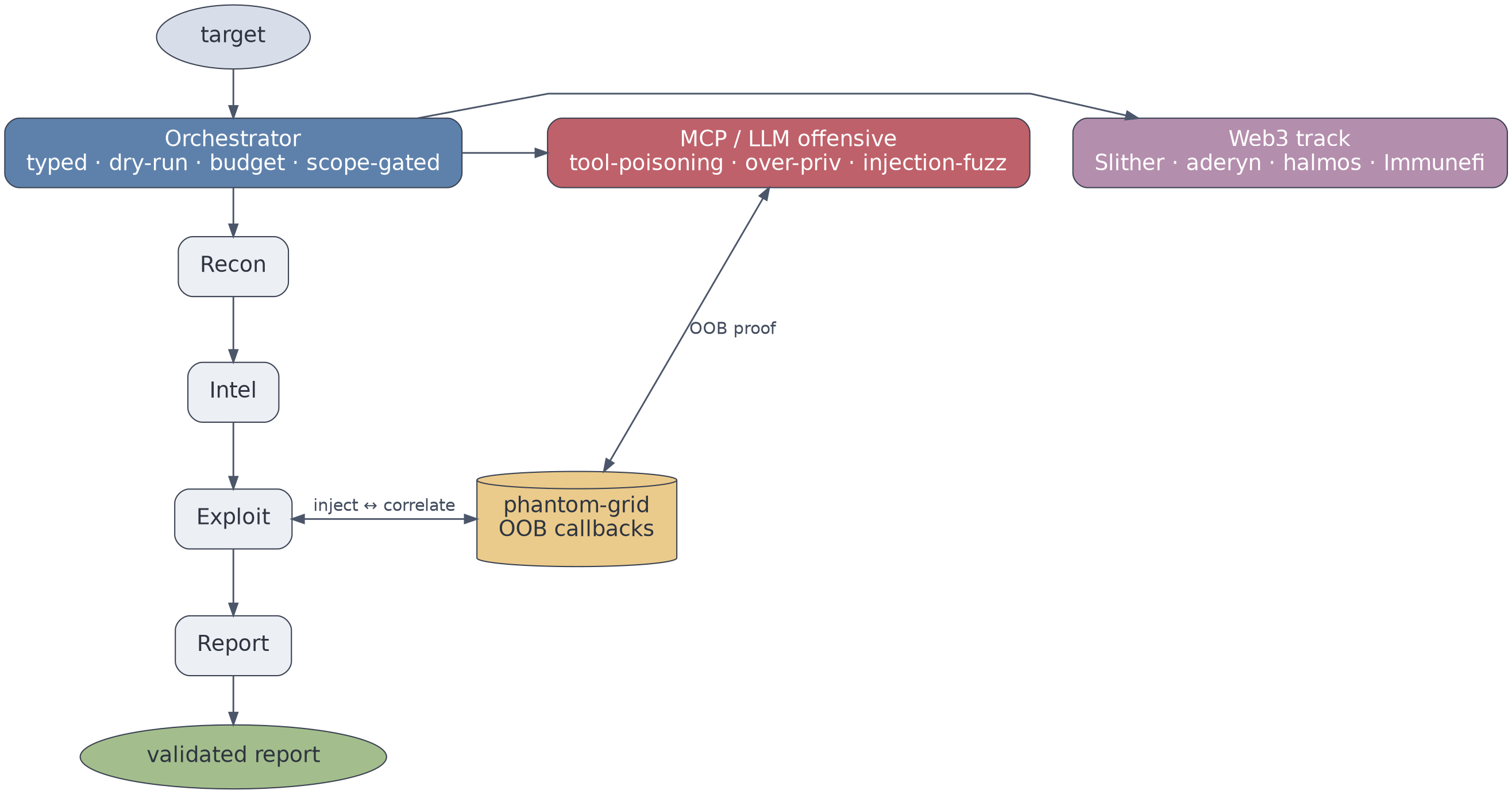
Diagram source (Mermaid, rendered on GitHub)
flowchart LR
    T([target]) --> O[Orchestrator<br/>typed · dry-run · budget · scope-gated]
    O --> R[Recon] --> I[Intel] --> E[Exploit] --> RP[Report] --> V([validated report])
    E <-->|inject ↔ correlate| PG[(phantom-grid<br/>OOB callbacks)]
    O --> W3[Web3 track<br/>Slither · aderyn · halmos · Immunefi]
    O --> MCP[MCP / LLM offensive<br/>tool-poisoning · over-priv · injection-fuzz]
    MCP <-->|OOB proof| PG
Trust boundary — one guard inside
LLMClient, ahead of every provider call; phase edges are audited on top of it, in both pipelines. Findings reach confidence = 1.0 only when confirmed out-of-band via phantom-grid.
Observability: JSONL audit log · session export/import · cyberai replay
Interfaces: CLI · FastAPI dashboard (SSE) · MCP server (Claude Desktop)
| Agent | Input | Output | Key tools |
|---|---|---|---|
| Recon | target | open ports, DNS, WHOIS, subdomains | nmap (flag-whitelisted), async DNS, subdomain enum |
| Intel | recon kb | ranked CVEs | NVD client, EPSS enrichment, risk prioritizer |
| Exploit | intel kb | attack paths, OOB findings | nuclei, searchsploit, OOB/SSRF/XXE workflows |
| Report | session kb | structured Markdown / H1 export | LLM summary + LLM-as-judge validation |
| Web3 | .sol path / address | severity-tiered findings | Slither, Etherscan, Immunefi classifier |
CyberAI is an actively developed platform, not a scaffold. Shipped and tagged:
| Version | Focus | Highlights |
|---|---|---|
| v1.0 | Core platform | typed 4-phase pipeline, OOB exploitation, Web3 (Slither/Immunefi), MCP server, LLM-as-judge, scope import, async, cost tracking |
| v1.1 | Proof & benchmarks | reproducible bench harness + local vuln suite, honest scorecard, per-phase model router, air-gapped path (egress guard) |
| v1.2 | MCP/LLM offensive red-team | MCP probe + scan CLI, tool-poisoning & over-privilege detectors, live injection fuzzer, attestation checks, MST bridge |
| v1.3 | Web3 discovery | aderyn cross-validation, halmos symbolic runner, Foundry on-chain PoC, access-control agent, EVMBench adapter, Immunefi export |
| v1.4 | Autonomy & unified reporting | graph planner driving exploit order, exploit-memory recall, unified OOB confirmation, behavioral fingerprinting, findings grouped by attack surface |
| v1.5 | The HTTP surface | API-spec and JS-bundle route discovery, authenticated walks, object-level authorization checks, out-of-band confirmation on the product path |
| v1.6 | Honest release | one trust boundary in front of the model with three policies, decontaminated proofs, the agent score published, Apache-2.0 |
Next: wider public proof — benchmark re-runs published as a tracked delta, sample reports for each attack surface, and reproducible live runs.
- One trust boundary in front of the model —
TrustGuard.inspect()sits insideLLMClient, ahead of the provider branch, on all four entry points. Nothing reaches OpenAI, Anthropic or Ollama without passing it. It scores the raw message and sanitises the copy it sends: the reverse order was measured to blind the detector, because sanitisation strips three of the categories the detector scores on, so a payload carrying a template marker scored lower through the guard than raw. System prompts are never rewritten — only user, tool and function messages are attacker-reachable. - Three policies, one variable —
CYBERAI_INJECTION_POLICYselectsannotate(default: label the content as untrusted, send it, record the verdict),quarantine(label, replace each match with[REDACTED:<category>], cap the length), ordeny(raise; the provider is never contacted). Pickannotatewhen a false positive must not corrupt legitimate input,denyfor an engagement where a suspected injection should stop the run.quarantineis not the default on purpose: it mutates content, and the detector it would run on has no published precision. The figure behind that choice — 42 flagged of 43 real scan reports — was taken on a corpus that is not tracked in this repository and no longer exists. It is kept incore/security/guard.pyas the recorded reason for the default, not as a reproducible measurement.quarantinebecomes the default when W3 publishes precision and recall on a tracked corpus. - Every verdict is in the audit trail — policy, threshold, score, categories and how many messages were modified, written per call. Message bodies stay out of it.
- Prompt-injection detection — 31 patterns across 10 weighted categories. Also run on each phase's output, where a hit becomes a MEDIUM finding. That pass is an audit signal, not a barrier: it runs after the agent has already called the model, and it is labelled as such in the code and the report. The barrier is the guard above.
- Scope enforcement — wildcard +
!-exclusion matching honors HackerOne / Bugcrowd briefs (cyberai scope import). - Audit trail — every agent action logged to JSONL with full
inputs/outputs; sessions are replayable. Every line is HMAC-signed —
cyberai audit-verify <file>reports any line edited after the run.
git clone https://github.com/evkir/CyberAI.git
cd CyberAI
pip install -e .
cp config.example.yml config.yml
cp .env.example .env
# Edit .env — add OPENAI_API_KEY or ANTHROPIC_API_KEY (not needed for --dry-run)# Dry-run: walks all 4 phases, no network, no API key
python -m cyberai scan example.com --dry-run
# Real scan, scope-restricted
python -m cyberai scan target.htb --scope '*.target.htb'
# Replay a saved session deterministically
python -m cyberai replay <session_id>
# Import a bug-bounty scope
python -m cyberai scope import h1 --program acme
# Status / config
python -m cyberai statusuvicorn cyberai.web.app:app --reload
# http://127.0.0.1:8000 — session list, live SSE progress, report viewpython -m cyberai.mcp.serverExposes recon/intel tools (nmap_scan, dns_enum, cve_search,
epss_score, …) plus mcp_scan — which lets the server scan other MCP
servers — over the Model Context Protocol. See
docs/mcp/integration.md.
cyberai mcp-scan http://target.example.com/mcp --reportInventory a target MCP server or LLM endpoint and emit an OWASP-MCP / MITRE-ATLAS red-team report. See docs/redteam/mcp-scanning.md.
# config.yml
llm:
  provider: openai        # openai | anthropic
  model: gpt-4o
  max_tokens: 4096
  temperature: 0.2

phantom:
  grid_url: http://127.0.0.1:9090

output_dir: reports/
max_cost_usd: 0.0 # 0 = disabled; set to enforce a budgetEvery setting can be driven from the environment (or a .env file - see
.env.example). Feature flags are off by default
(no-regression); enable any with 1/true/yes/on.
| Variable | Effect |
|---|---|
CYBERAI_LLM_PROVIDER / CYBERAI_MODEL |
LLM provider and model |
CYBERAI_USE_BEHAVIORAL |
Honeypot/WAF/tarpit fingerprinting in recon |
CYBERAI_USE_PORT_FINGERPRINT |
Banner grab on ports nmap could not name |
CYBERAI_USE_NUCLEI |
Nuclei template exploit engine |
CYBERAI_USE_JUDGE |
LLM-as-Judge report validation |
CYBERAI_ENABLE_REPLAN |
Critic-driven phase replan |
CYBERAI_USE_EXPLOIT_MEMORY |
Recall similar past exploit chains |
CYBERAI_AIR_GAPPED |
Force local-only (no-egress) LLM path |
CYBERAI_STRICT_SCOPE |
Refuse the exploit phase when no scope was given |
CYBERAI_ENABLE_MODEL_ROUTING |
Per-phase model selection |
CYBERAI_MAX_COST_USD |
LLM spend budget (0 = disabled) |
CYBERAI_OUTPUT_DIR |
Report output directory |
CYBERAI_SESSION_SECRET |
Audit-trail signing key; unset means a published fallback |
The scan command overrides the main flags per run, in either direction:
cyberai scan example.com --behavioral --nuclei
cyberai scan example.com --no-air-gappedCyberAI measures its own engine against a small, self-contained suite of deliberately-vulnerable targets it authors and serves — no third-party benchmark required to reproduce the numbers.
cyberai bench list
cyberai bench run --suite local --engine agent --scorecard reports/scorecard-agent.md
cyberai bench run --suite local --engine real  --scorecard reports/scorecard.md
Every published number is reproducible (targets ship in cyberai/bench/apps/),
binary (solved only on an unambiguous success signal from a responding
target — never "looks exploited"), and traceable (each run emits a scorecard
with engine version, provider, model, timestamp).
Latest run of the local suite (CyberAI 1.6.0, 2026-08-26), scored twice — once by the pipeline that is the product, once by the fixed probes. Both reach 4/4:
| vuln class | solved | total | rate |
|---|---|---|---|
| sqli | 1 | 1 | 100% |
| command_injection | 1 | 1 | 100% |
| path_traversal | 1 | 1 | 100% |
| ssrf | 1 | 1 | 100% |
| pass@1 | 4 | 4 | 100% |
What the pipeline spent reaching that score. The probes produce none of these numbers, which is why the card beside this one has no metrics section:
| task id | in-band | out of band | endpoints | requests |
|---|---|---|---|---|
| local-sqli-login | 2 | 0 | 1 | 5 |
| local-cmdi-ping | 1 | 0 | 1 | 3 |
| local-path-traversal | 1 | 0 | 1 | 3 |
| local-ssrf-fetch | 0 | 1 | 1 | 10 |
| total | 4 | 1 | 4 | 21 |
Two engines, one suite, answering different questions. --engine real drives
fixed per-class probes: 4/4 there means the targets are exploitable and the
harness works — it measures the bench, not the product. --engine agent
drives the full pipeline, which is handed an address and has to discover the
surface before it can attack it; 4/4 there is the product finding and proving
four flaws on its own. The second is the number worth publishing, and it is
the one above.
Read the zero honestly: the pipeline reaches 4/4 without contacting a
model. The agent engine constructs no LLM client on this path, and the card
records that rather than implying it — llm calls 0, llm zero reason engine_uses_no_model, a proven zero instead of a blank nobody counted.
Discovery, payload selection and proof are code here, not inference. The
model earns its place elsewhere: reading a surface larger than four
endpoints, the analysis and the report. Publishing this suite as evidence of
a language model solving CTFs would be the easy lie — it solved them with no
model at all.
In-band and out-of-band are counted apart because of the blind SSRF target: it answers identically whichever way the fetch goes, so it is proven by a callback carrying the run nonce, and folding that into the in-band column would print a zero on a task that was solved.
Read the suite honestly too: it is authored by the project it measures. It proves the engine works end-to-end against live targets in Docker and guards against regression between releases — it is not a competitive result and is not comparable to CVE-Bench or CyBench. The one external suite run so far, CVE-Bench, scored 0/3 on three selected tasks; the runs and the reason are in docs/benchmarks/cve-bench.md.
Part of an earlier 4/4 was self-referential — the exploitation engine held a literal from a target this project wrote. What was wrong, what changed and what the numbers did afterwards is written up in docs/benchmarks/contamination-2026-08.md.
Both cards are committed:
scorecard-agent.md for the
pipeline, scorecard.md for the probes.
The run manifest is not, and --manifest <path> reproduces it.
The default --engine placeholder reports all-unsolved by design so a scorecard
never overstates capability; --engine real runs live per-class probes. External
suites (CVE-Bench, CyBench, EVMBench) plug into the same BenchTask contract as
optional adapters for leaderboard parity — never as a product dependency.
See docs/benchmarks/local-suite.md for the methodology and the current scorecard.
| Doc | What |
|---|---|
| docs/api/agents.md | Agent API reference |
| docs/exploit/oob-exploitation-workflow.md | OOB / SSRF walkthrough |
| docs/web3/web3-audit.md | Smart-contract audit for Immunefi |
| docs/mcp/integration.md | MCP server setup |
| docs/redteam/mcp-scanning.md | MCP/LLM offensive red-team scanning |
| docs/security/adversarial-robustness.md | What the trust boundary covers, and what it does not |
| docs/research/detector-v2.md | The three detector layers, what each was measured at, and what was not measured |
| examples/detector-eval/baseline.md | Detector precision and recall on the tracked corpus, per technique |
| docs/benchmarks/local-suite.md | The local suite: targets, success signals, methodology |
| docs/benchmarks/reproducibility.md | What a run pins, what it records, what it cannot promise |
| docs/benchmarks/contamination-2026-08.md | A self-referential proof, how it was found, what the numbers did |
| docs/benchmarks/cve-bench.md | The external suite, scored 0/3, with the cause |
| docs/architecture/known-issues.md | Known defects and gaps, named rather than implied |
| docs/workflows/htb-with-cyberai.md | Walkthrough: a lab box end to end |
| docs/workflows/web3-discovery.md | Walkthrough: contract discovery to Immunefi export |
| docs/usage/examples.md | Command recipes by task |
| docs/setup/nvd-apikey.md | NVD API key setup for CVE lookup |
| docs/licensing.md | Apache-2.0, the CLA, and the planned transfer to the LLC |
| Tool | Role |
|---|---|
| phantom-grid | OOB interaction capture |
| phantom-intel | CVE intelligence feed |
| reality-probe | TLS front fitness scoring (standalone) |
- Python 3.11+
- OpenAI or Anthropic API key (not required for
--dry-run) - Optional: phantom-grid (OOB), nuclei, slither, NVD API key
CyberAI is an offensive-security tool intended strictly for authorized security testing, research, and education. Use it only against systems you own or for which you hold explicit, written permission (e.g. a signed engagement, an in-scope bug-bounty program, or a lab you control).
- Unauthorized scanning, exploitation, or access of systems is illegal in most jurisdictions and is not condoned by this project.
- You are solely responsible for ensuring your use complies with all applicable laws and with the rules of any target program.
- The software is provided "as is", without warranty of any kind. The authors and contributors accept no liability for misuse or for any damage arising from its use.
By using CyberAI you agree to operate within these bounds.
Apache-2.0 — see LICENSE and NOTICE.
Releases up to and including v1.5.0 were published under MIT and remain available under those terms. Contributions require a signed CLA; the reasoning is in docs/licensing.md.