

Rig compiler for Spine. Declarative rig specs in, Spine 4.3 skeleton data out,
verified by a spine-core round-trip. Built so AI agents can author rigs and check
their own work.
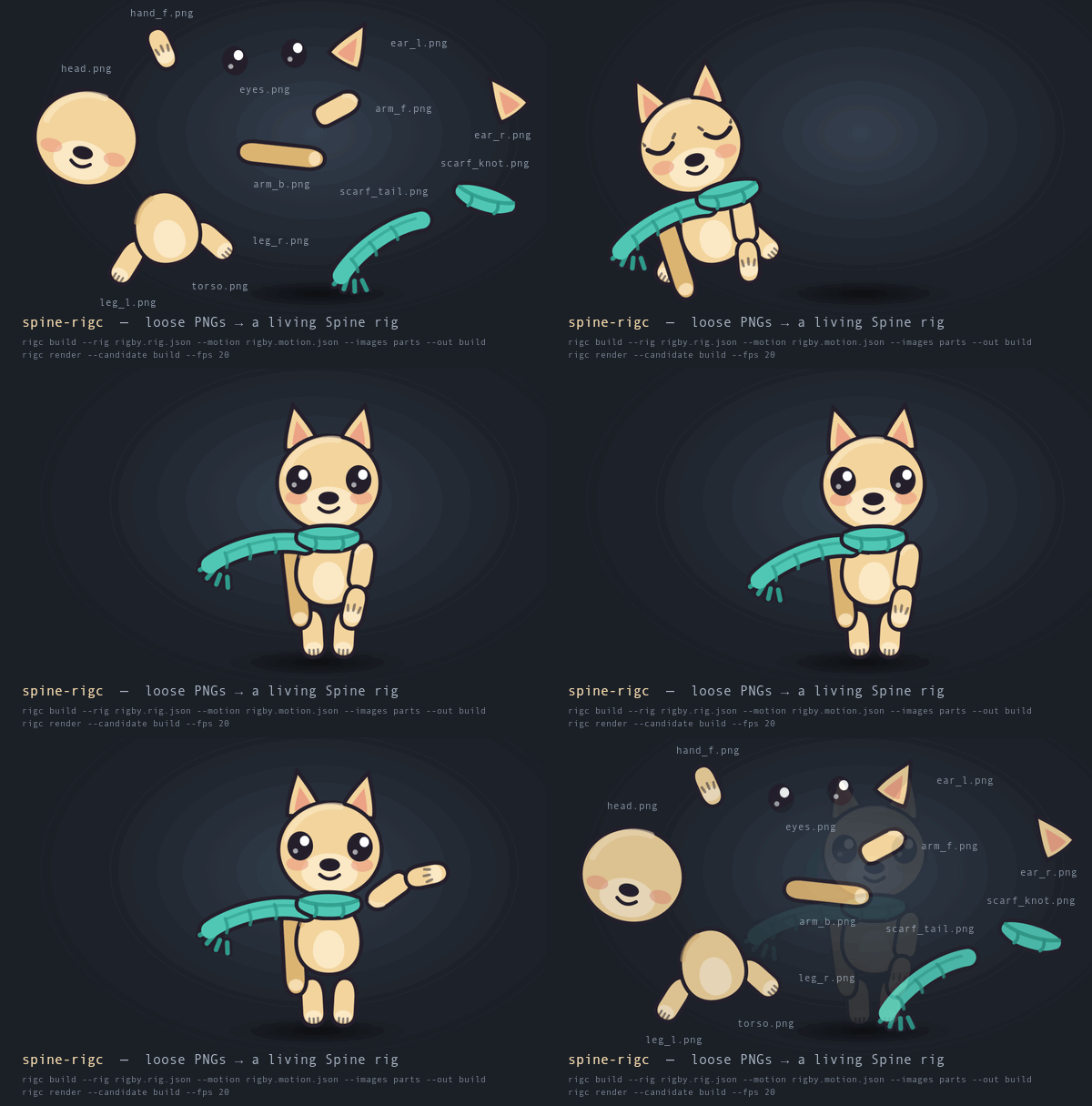
Fourteen part PNGs drawn from scratch for this repo, one rig spec, one motion spec — the assembly,
the breathing and the wave are all rigc-compiled Spine animations, rendered with
rigc render.
Loose part PNGs and two small JSON files in; Spine 4.3 skeleton data out — a
skeleton.json and a skeleton.atlas that load in any Spine runtime and import
into the Spine editor. Nothing is written unless a round-trip through Spine's own
parser and a list of named assertions all come back green.
| You have | You run | You get |
|---|---|---|
| part PNGs, a rig spec and a motion spec | rigc build |
skeleton.json + skeleton.atlas — or a failure named by rule, and nothing on disk |
| the same, and one texture instead of many | rigc build --pack |
the parts arranged onto shared atlas pages, written beside the skeleton — losslessly, so the picture is the picture |
| a pack somebody already made | rigc build --atlas-in |
the same skeleton, with every part resolved to a region of that atlas — or a named refusal, never a part that silently does not draw |
| a compiled rig | rigc render |
every animation as PNG frames, plus one labelled contact sheet of the whole shot |
| a compiled rig | rigc preview |
one self-contained .html that plays it in Spine's own web player |
| two to four compiled rigs | rigc vote |
one ballot page a human picks from, and the answer checked into a ledger |
| a picture of a key pose | rigc pose |
where each loose part PNG sits in it, in spec coordinates — the movement between two poses is then yours to key (docs/MOTION.md) |
| the same picture, and a rig | rigc chainfit |
the parts pose refuses because something is drawn over them — read through the candidate's own draw order and hierarchy, with the share of each part the answer was measured on |
Everything in that table needs Bun and this package: no clone, no reference art, no art pipeline, no server.
rigc emits Spine's own skeleton data format. That is the whole positioning, and it cuts both ways:
- The output loads in any Spine runtime, and it imports into the Spine editor.
A compiled rig is a starting point on a timeline, not a finished shot — an AI
drafts, a human refines in the editor. That hand-off is what emitting somebody
else's format buys, and
tools/editor_roundtrip.tsmeasures that it survives the trip in both directions. - rigc links
@esotericsoftware/spine-coreto validate what it emits — the round-trip through the official parser is the only reason its output can be trusted at all. So the Spine Runtimes License Agreement applies to rigc exactly as it applies to any other runtime integration.
🗓️ One sentence left this section on 2026-09-05, and its removal is a decision
rather than a tidy-up. It read "rigc is complementary to the editor. It is not
a replacement for it, and it is not a way around one." That was a claim about
what rigc would never become, and
#380 — a format-agnostic core with
its own format and web player, Spine kept as one backend among others — is a
course the claim cannot survive. A promise the roadmap contradicts is worth less
than no promise, so it is retired rather than reworded
(#398). What a reader can check is
unchanged: rigc emits Spine skeleton data, links spine-core, validates through
it with no flag that turns that off, and carries the licence obligation the next
section states in full. A backend emitting something other than Spine data would
have no spine-core to check it against, and #380 treats an oracle of its own as
the prerequisite for shipping one — nothing here makes an unchecked emit path
acceptable.
rigc's own code is MIT (see LICENSE). That says nothing about Spine, and the following is a restatement of Esoteric Software's terms, not a term of ours:
- rigc's output is Spine skeleton data.
- Playing Spine skeleton data in a product requires a Spine Runtime.
- The Spine Runtimes License requires each user of such a product to own a Spine editor licence.
- rigc links
spine-coreitself, so the same obligation covers running rigc.
Using rigc, or shipping rigc's output in a product, requires a Spine editor licence. rigc does not change that requirement in either direction — it neither adds one nor removes one. If you were going to need an editor licence to ship a Spine animation, you still do; rigc is not a route around it.
See NOTICE.md for the full notice.
📐 What of Esoteric Software's is in this repository, and under what grant. No
example asset is committed: bun run fetch-examples downloads the example projects
into a gitignored examples/. What is committed is bench/reference/ — 1,293 PNG
frames this project renders from those examples' own exports, so a frame carries
those images' pixels and committing one is redistribution. Each example's own
license.txt permits exactly that, "as long as they are accompanied by this license
file", and a verbatim copy of it sits at each example root here — all eight, written
there by the render script rather than left to memory. The same file's
non-commercial condition rides along with those images, and
LICENSE says so: rigc's MIT grant covers rigc's own code, documentation
and art, not this material. 7-anticipation publishes no license.txt upstream, so
no such grant exists for it and its frames are never committed — they render only
into a gitignored directory, enforced by git check-ignore. Full reasoning:
bench/reference/README.md
(repository material, not in the npm package).
The problem rigc is aimed at is narrow. An agent asked to author a rig has no way
to tell whether it succeeded: Spine's JSON parser accepts a great deal of nonsense
without a murmur — a constraint in the 4.2 shape simply vanishes, a size: that
disagrees with the PNG collapses every UV, a four-number curve array yields NaN,
a mesh whose vertex count happens to equal its UV count silently loses its bone
weights. Every one of those loads clean, plays, and is wrong. rigc's answer is to
make the failure legible: compile from a spec, round-trip through the real parser,
run a list of named assertions, and write nothing unless all of them are green.
📦 rigc measures loose PNGs directly, and emits one atlas page per image unless
you ask otherwise. rigc build --pack arranges every part onto shared pages and
writes them into --out; --atlas-in builds against a pack somebody else made.
Both are opt-in and both are narrow — no trimming, no rotation, no scaling — and
AUTHORING §0.1–§0.2 states the limits before you hit them.
rigc runs on Bun. The package ships its TypeScript sources and
Bun runs them, so there is no build step and no dist/ that can drift from the
repository it was cut from.
The npm package is spine-rigc; the command it installs is rigc. npm
refuses the name rigc as too similar to packages that already exist, so the
project, this repository and the executable keep their name and only the
registry entry is spelled out.
bunx spine-rigc --help    # run it without installing
bun add -g spine-rigc     # or install the command
bun add -d spine-rigc     # or pin it in a project
npx spine-rigc works too, as long as Bun is on PATH — the executable is a
Bun script, and npm only writes the shim that calls it.
Installed, the command is rigc. The examples below spell it bun cli.ts
because they are written from a clone of this repository (bun install, then run
the CLI in place); the two are interchangeable — rigc build … is
bun cli.ts build ….
Two commands are repository workflows rather than package ones: bench and
check measure against Spine's official example projects — fetched, never
committed — and against reference frames this project renders from them, which
are committed, each example's own license.txt beside them under the
redistribution grant those files carry; the images stay non-commercial only.
The reasoning is in
bench/reference/README.md
and the terms in NOTICE.md. Both commands need a clone and bun run fetch-examples, and say so by name when the corpus is absent.
The guides under Documentation also ship as
Agent Skills — skills/<name>/SKILL.md, in this
repository and in the npm package — so an agent finds rigc the way it finds its
other tools. Each skill is a router and nothing more: when to load it, the
non-negotiables in a line apiece, and a link to the guide that owns every rule, so
a rule keeps living in exactly one place. The repository is also a Claude Code
plugin marketplace:
/plugin marketplace add firejune/rigc
/plugin install rigc@rigc
With the package already installed, claude --plugin-dir node_modules/spine-rigc
loads the same skills without a marketplace. The plugin carries no version of its
own — /plugin update follows main commit by commit, and the only version on
disk stays the one in package.json.
A whole rig, end to end, in a scratch directory: three tiny plates, two JSON
files, one build, one validate. No clone, no art pipeline, nothing fetched.
🚫 Every value below is invented for this section — a doll that exists nowhere else in this repository. That is AUTHORING.md §3's rule applied here: no example value in these documents is copied out of a reference export, so nothing you read in a quickstart is an answer to anything the ladder measures.
1. Install the command.
bun add -g spine-rigc # installs `rigc`Or skip the install and prefix every command below with bunx , e.g.
bunx spine-rigc build ….
2. Make a directory and three plates. rigc measures PNGs rather than trusting a number you typed (R5), so the art has to exist. These three are solid colours a few dozen pixels across — a hull, a mast and a lamp:
mkdir -p buoy/images && cd buoy
bun -e '
const parts = {
  "images/hull.png": "iVBORw0KGgoAAAANSUhEUgAAADgAAAAMCAYAAAA3bX6lAAAAKElEQVR42mOI8bL6P5wxw6gHRz046sFRD456cNSDox4c9eCoBwcrBgDSZ+mdl2OiDgAAAABJRU5ErkJggg==",
  "images/mast.png": "iVBORw0KGgoAAAANSUhEUgAAAAgAAAA0CAYAAAC3t3ldAAAAH0lEQVR42mO4dunIf3yYYVTBqIJRBaMKRhWMKhgcCgBGJo4s9YnopgAAAABJRU5ErkJggg==",
  "images/lamp.png": "iVBORw0KGgoAAAANSUhEUgAAABIAAAASCAYAAABWzo5XAAAAHElEQVR42mP4v8HhPzUww6hBowaNGjRq0HAzCADvdrVmFPbc+QAAAABJRU5ErkJggg=="
};
for (const [p, b] of Object.entries(parts)) await Bun.write(p, Buffer.from(b, "base64"));
'
3. The rig spec — buoy.rig.json. Structure only: bones, the slots array in
draw order, and one skin mapping each slot to a plate.
{
  "spec": "rigc-rig/1",
  "name": "buoy",
  "images": "images",
  "skeleton": { "width": 200, "height": 200 },
  "bones": [
    { "name": "root" },
    { "name": "hull", "parent": "root", "x": 0, "y": 0 },
    { "name": "mast", "parent": "hull", "x": 0, "y": 4 },
    { "name": "lamp", "parent": "mast", "x": 0, "y": 52 }
  ],
  "slots": [
    { "name": "mast", "bone": "mast", "attachment": "mast" },
    { "name": "hull", "bone": "hull", "attachment": "hull" },
    { "name": "lamp", "bone": "lamp", "attachment": "lamp" }
  ],
  "skins": {
    "default": {
      "mast": { "mast": { "image": "mast.png", "y": 26 } },
      "hull": { "hull": { "image": "hull.png" } },
      "lamp": { "lamp": { "image": "lamp.png" } }
    }
  }
}
Three things in there are worth naming, because each is a rule rather than a
style: the slots array is the setup draw order (R4) — index 0 is furthest
back, so the mast is behind the hull; the attachment carries an image
instead of a width/height (R5), which is what makes the size in the
skeleton and the size in the atlas incapable of drifting apart; and the mast's
"y": 26 offsets the plate within its slot so the bone sits at the mast's foot
rather than its middle.
4. The motion spec — buoy.motion.json. Time only, aimed at the rig by name:
{
  "spec": "rigc-motion/1",
  "archetype": "buoy",
  "cut": "buoy",
  "easings": { "swing": [0.42, 0, 0.58, 1] },
  "animations": {
    "bob": {
      "duration": 2,
      "loop": true,
      "tracks": [
        {
          "bone": "hull",
          "property": "translatey",
          "keys": [
            { "t": 0,   "v": [0],  "ease": "swing" },
            { "t": 0.5, "v": [5],  "ease": "swing" },
            { "t": 1.5, "v": [-5], "ease": "swing" },
            { "t": 2,   "v": [0] }
          ]
        },
        {
          "bone": "mast",
          "property": "rotate",
          "keys": [
            { "t": 0, "v": [-6], "ease": "swing" },
            { "t": 1, "v": [6],  "ease": "swing" },
            { "t": 2, "v": [-6] }
          ]
        }
      ]
    }
  }
}
archetype must equal the rig's name. duration is declared and then checked
against what actually compiled (R7). The last key of each track carries no
easing — there is nothing after it to ease towards, and saying otherwise is a
compile error.
5. Build, then re-gate what it wrote.
rigc build --rig buoy.rig.json --motion buoy.motion.json --images images --out spine
rigc validate spine
build prints every assertion by name, then the shape of what it emitted, then
the two files:
  ..    pages=3 regions=3 bones=4 slots=3 animations=1 version=4.3.13 regionAttachments=3 meshAttachments=0 physicsConstraints=0 rig=buoy profile=spine
rigc: wrote …/buoy/spine/skeleton.json
rigc: wrote …/buoy/spine/skeleton.atlas
profile=spine is the rulebook that judged it: is this valid Spine 4.3 that any
runtime plays correctly? That is the default, and the Profiles
section of the benchmark dossier is where the other one lives. validate then re-reads those
artifacts from disk and ends rigc: green. That is a rig. spine/skeleton.json
is Spine 4.3 skeleton data — it loads in a Spine runtime and it imports into the
Spine editor.
Try breaking it, because the validator's messages are the interface here and
they are worth meeting once on purpose. With spine/ built, rename
images/hull.png to images/raft.png and re-run rigc validate spine:
FAIL  A17_ATLAS_PAGE_FILES_EXIST: page "../images/hull.png" is not on disk at …/images/hull.png
rigc: 1 assertion(s) failed
Put the name back and it is green again. The same gate runs inside build, and
a FAIL there stops it before it writes — a red build leaves no half-built
artifact on disk to mistake for a result, and there is no flag that changes that.
6. See what you built.
🚨 Green is a claim about validity and about nothing else. A rig whose head
sits visibly off its torso passes every assertion, loads in spine-core and steps
numerically clean — the offsets are the ones your spec asked for, and no
assertion can know you did not mean them. The only remedy is looking, and both
commands below need nothing you do not already have: no reference frames, no
second package, no server.
rigc render  --candidate spine          # PNG frames + a contact sheet, in render/
rigc preview --candidate spine          # one .html file that plays it: preview.html
render samples every animation at 12 fps and writes render/<animation>/f0000.png…
with a contact.png beside them — every frame of the shot as one labelled grid,
which is the picture to open first, because spacing is a comparison across
frames. It draws with rigc's own rasteriser (the one check measures with), so
it needs no browser and no network, and the frames.json it leaves beside the
directories makes the result a frame set like any other — the world box every
frame is a picture of. --animation <name> narrows it to one, --fps and
--max change the rate and the frame size.
preview writes a single self-contained .html: your skeleton, your atlas
and every page's PNG bytes are embedded in it as data URIs, and it plays them in
the official Spine Web Player.
Double-click it, or attach it to a message — the file carries the whole artifact.
It is also the strongest interop statement in this repository: a rig that plays
there has been played by Esoteric Software's own runtime rather than by ours.
⚖️ The player itself is referenced, not embedded — the page loads it from unpkg, so the first open needs a network, and rigc redistributes nothing Esoteric Software owns (see NOTICE.md). Everything the player draws is inside your file.
7. Let someone choose. Sooner or later you will have two builds that both pass
the gate and no instrument that can separate them. vote puts them in one page
side by side, labelled A and B with no paths on screen, and takes an answer
back:
rigc vote --candidate spine-a --candidate spine-b   # -> ballot.html, open it and pick one
rigc vote --record vote-<id>.json                   # -> checks the answer into votes.jsonl
The voter picks a winner or says "tie / no preference"; the page hands them a
small JSON file to save; --record checks that file against the ballot's own
hashes and appends one line to an append-only ledger, refusing by name anything
that does not belong to it. See
Letting someone choose.
Where to go next.
- 📘 docs/AUTHORING.md is the real guide — both files
field by field, the emission rules, every named failure mapped to the file that
has to change, and §8–§9 for reproducing a shot you were given as pictures. It
ships inside the npm package too, at
node_modules/spine-rigc/docs/AUTHORING.md. rigc explain --rig buoy.rig.json --motion buoy.motion.json --out spineprints the compiled rig as a table — every bone with its resolved parent, the slots in draw order, every timeline key by key — and writes nothing. It is what to reach for when a rig compiles and still looks wrong.- 🚨 A green gate does not mean the animation is right, and no assertion
could. If you have reference pictures of the shot,
rigc check --candidate spine --frames <dir>is the half of the loop that can see a wrong animation — AUTHORING.md §9. - docs/LADDER.md is the benchmark: the same job, from a brief and rendered frames, scored. docs/PILOT.md is how to run an agent through it and score what comes back.
- 🤖 Handing the authoring to an AI agent? docs/PROMPTING.md is the operator's page — the six prompt clauses a measured pilot run paid for, and what you can leave unsaid.
Steps 6 and 7 above are the three commands that need nothing but a compiled rig — no
reference frames, no second package, no server. render writes every frame as a
PNG plus one contact-sheet grid of the whole shot; preview writes one
self-contained .html that plays it in Spine's own web player; vote puts two to
four candidates in one page and takes a human's answer back. Reach for them the moment
a rig compiles green, because green says nothing at all about the picture.
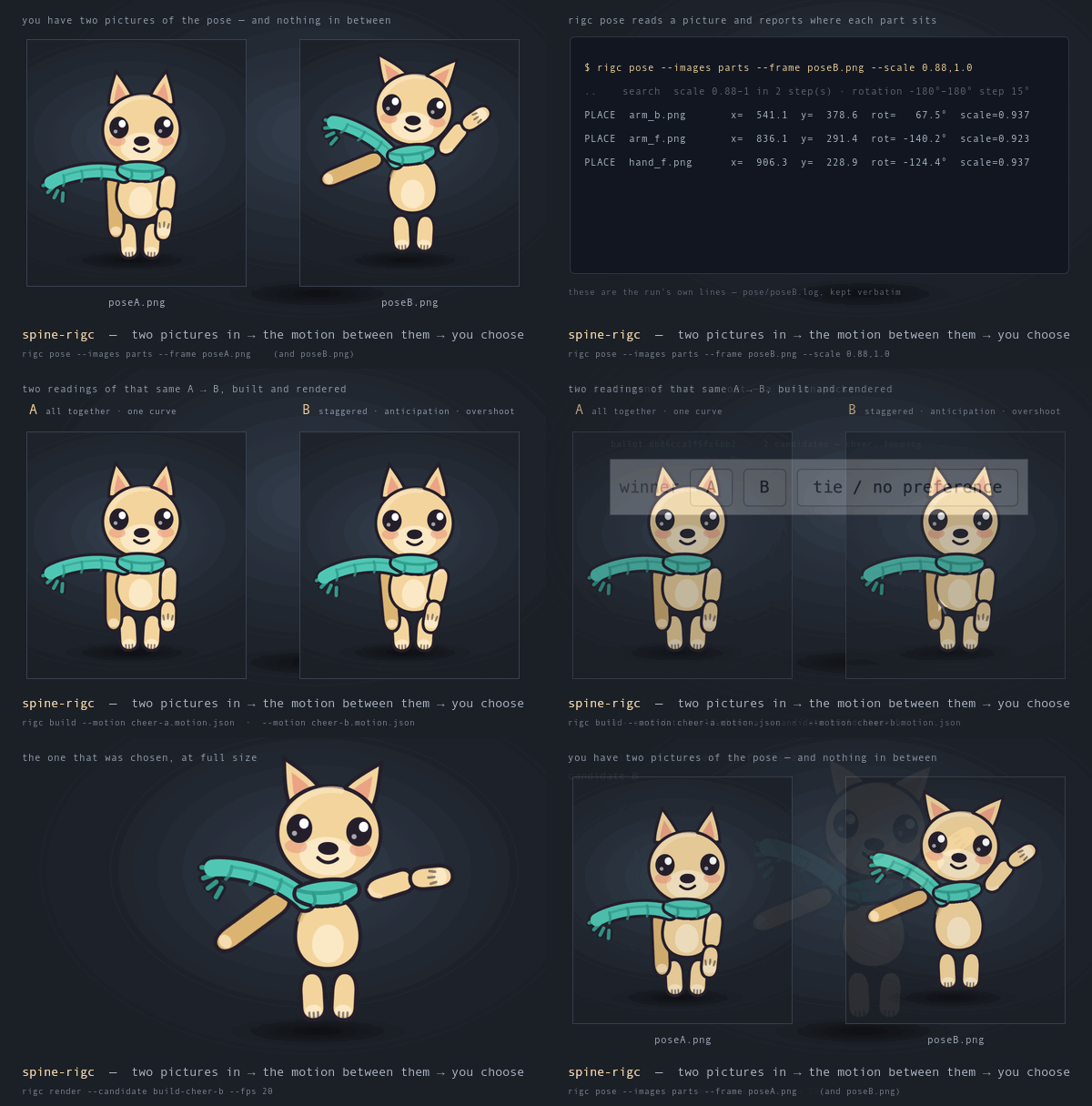
The whole loop on one character: two key poses are the given
conditions, rigc pose reads where every part sits in each picture, two
candidate in-betweenings are compiled from the same pair — and a real
rigc vote ballot picks the winner, because the movement between the poses
is the one thing no instrument here will grade.
Three properties of vote are worth stating, because they are what make its ledger
usable by the next agent rather than by a reader: a tie is a recorded outcome, not a
missing one — both-unacceptable is the tie that means propose again, and it is
unreachable if ties are not recordable; the winner is a digest, not a label, since
B means nothing outside one ballot while a digest identifies the same pixels
anywhere; and every line carries a reason code from a closed enumeration that is
enforced, so "tie, because this one is better" is refused.
🎞️ Authoring the movement those pages show you — key poses, in-betweening, and how to spread candidates so a ballot informs — is docs/MOTION.md.
📐 rigc pose --images parts/ --frame poseA.png runs the other way. Every command
above takes something you authored and tells you about it; this one takes a picture
the user already has — one key pose — and reports where each loose part PNG sits in
it, so those coordinates go into the rig and the motion by construction and the
effort goes into the part no instrument can measure: the movement between two poses.
A part that matches nowhere is refused by name, two near-equal placements are reported
as both, and nothing it prints is a score. Fields, the coordinate contract and the
limits: AUTHORING.md §11. The parts it refuses because
something is drawn over them are rigc chainfit's, once a candidate exists —
§12.
Each directory in gallery/ is
one rig spec, one motion spec and the PNGs they name, small enough to read in one
sitting. Each stars a single feature, so how do I do X has a working answer rather
than a field table, and each README carries the frame rate it was authored at, what
was verified, and what writing it cost. Repository material: a clone and
bun install runs them.
| Example | Stars | What it is |
|---|---|---|
gallery/walk |
ik constraints + ik timelines |
Two two-bone leg chains solved to foot targets — the planted leg nailed down, the swinging one let go at the top of its lift |
gallery/squash |
deform timelines |
A ball squashed about its contact point and stretched along its travel, from two affine transforms the keys state rather than tabulate |
gallery/flex |
contour meshes |
A swallow-tailed banner and a serrated leaf: four meshes traced off their own alpha, waved by bone timelines and rippled by a deform |
gallery/ride |
path attachments + path constraints |
A trolley coasting down a drawn rail and rolling back, driven by a position timeline, with groups + stagger keying the wheels and the ears |
gallery/portrait |
deform transform + derive group tracks |
A 2.5D head turn: two meshes and six feature bones all keyed from one stated expression, dx = x(cos t − 1) − z·sin t, with the depths in the spec rather than a README |
gallery/nod |
the pitch and wave transform kinds |
A head bowing and two lop ears rippling, on three meshes each laid out for the closed form that moves it — a fold angle solved for before authoring, and a shear whose winding no amplitude can reverse |
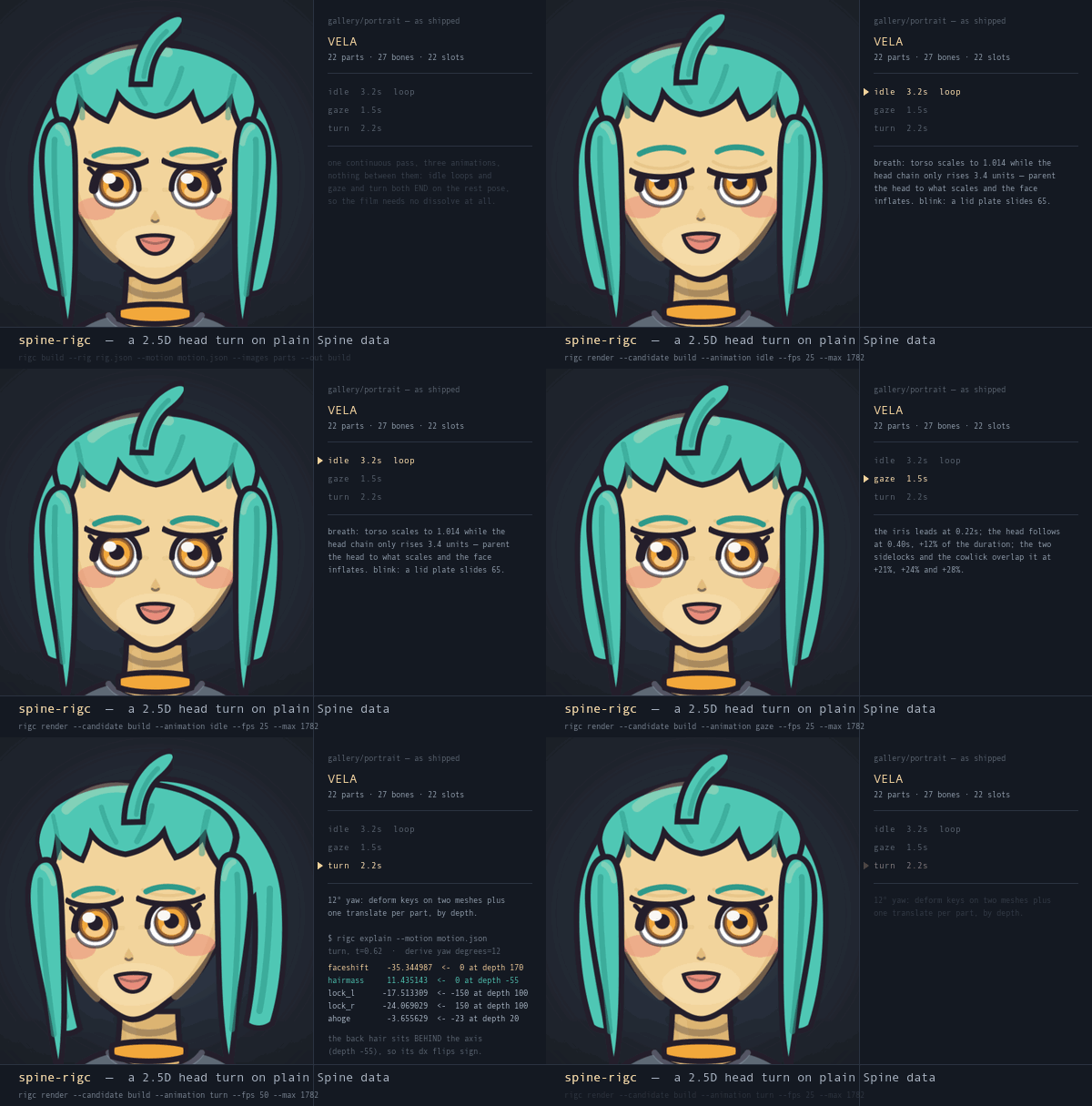
The portrait rig playing its three animations in one take — the turn is
the shot: both silhouette edges move apart, which a flat slide cannot do, because every
feature carries its own depth. The rig guarantees the seams — idle loops
while gaze and turn return to rest, so the hand-offs meet at 0
differing pixels — and the composing is the consumer's. Authorable on plain Spine 4.3, no
plugin, no runtime patch; the split was authoring cost rather than runtime capability, and
the cost is now one stated expression per key. Compiled and rendered entirely by the
published package.
🎞️ How the three films on this page were made is kept with them, one directory per
film in films/ — a run.sh that
names every step, the assembler that cuts the shots and draws the type, and a README
saying what the film claims and which tool printed each figure on screen. Repository
material, like the gallery: a clone runs them.
Every command takes its paths explicitly. rigc <command> --help prints its flags, and
AUTHORING.md §0 is the same list with what each flag means, which
commands take it and what its default is.
| Command | Does |
|---|---|
build --rig … --motion … --out … |
compiles, gates, and writes only if the gate is green. --images <dir> says where the rig spec's image names resolve, --manifest adds measured art, and --copy-images copies every page PNG into --out so the directory is self-contained, with skeleton.images pointing at it so the editor's import finds the parts |
build … --pack |
the same build with every part arranged onto shared atlas pages, written into --out — losslessly, and gated a second time as the pair that ships. --page-size and --padding tune it |
build … --atlas-in <file.atlas> |
the same build with every part resolved to a region of an existing pack instead of a loose PNG; a name the atlas lacks, a size the spec disagrees with or a rectangle off its page is refused by name |
validate <dir> |
re-gates artifacts already on disk |
explain --rig … --motion … |
the compiled rig as a table — every bone with its resolved parent, the slots in draw order, every timeline key by key. Writes nothing. What to reach for when a rig compiles and still looks wrong |
render --candidate <dir> |
PNG frames plus a contact sheet, in render/ |
preview --candidate <dir> |
one self-contained .html that plays it |
vote --candidate a --candidate b |
one .html that asks a human which; vote --record <file> checks the answer into votes.jsonl |
pose --images <dir> --frame <png> |
reads part placements out of a picture |
chainfit --candidate <dir> --images <dir> --frame <png> |
reads the parts pose refuses, through the candidate's own draw order and hierarchy: masked residuals over visible pixels, one hinge per child instead of four degrees of freedom, and the rotate key value each answer implies. A bone with two or more anchored descendants is determined rather than searched, and the residual that over-determination leaves is reported |
diff <candidate.json> <reference.json> |
structural comparison of two skeletons, one ratio per measure and deliberately no combined score |
check --candidate <dir> --frames <dir> |
the candidate against reference pictures — the only instrument here that can see a wrong animation |
bench <rung> --candidate <dir> |
one rung of the benchmark ladder |
diff, check and bench measure against something you were given; the first two
work on any frames you have, and bench is a repository workflow that needs a clone
and bun run fetch-examples. The reasoning behind all three is in
the benchmark dossier.
build and validate both default to --profile spine — the 26 validity rules, which
ask is this valid Spine 4.3 that any runtime plays correctly? --profile spine-html
adds all 41: the other 15 are one renderer's policy and one canvas budget's, and they
fire on perfectly correct editor-produced Spine data, so reach for that profile when
you are shipping into that project rather than to be thorough. A report always names
the profile it ran and lists what that profile left out.
Several cuts can also be registered in a cuts.json and built by name
(build --cut my_cut --cuts path/to/cuts.json); every path in that table resolves
relative to the cuts.json file itself, so the table lives with the project that owns
the art. Its shape is under
Usage.
tools/editor_roundtrip.ts drives the loop the output's whole premise rests on:
build → import into the Spine editor → export back to JSON → gate, diff,
render and check the export against the build it came from.
bun cli.ts build --rig … --motion … --out build/ --copy-images
bun tools/editor_roundtrip.ts --build build/ --editor /Applications/Spine.app/Contents/MacOS/Spine
It prints the import and export exit codes, the validator's verdict on the
export, every diff measure that moved, check's mean MAE and worst drift per
animation, and a field-by-field list of what the editor rewrote. On its first
run it found three emitter defects — #368,
#369,
#370 — and then showed that a
human edit made in the editor survives the trip back.
🔒 It requires a licensed Spine editor on the machine, by construction, and
drives only the documented command line
— never the UI, and it produces nothing the editor did not produce. With no
editor present it refuses by name and exits non-zero, and so does the trial:
the trial cannot save projects or export animation data, so the refusal names
what it found — the executable, the bundle, the CFBundleName that bundle
declares, or the banner the binary prints about itself — rather than starting it
and failing downstream. Both refusals point at --exported <file>, which
measures an export the editor already made and is the half of this tool that
needs no editor at all.
⛔ The round trip is not, and must not become, a selftest control. bun run selftest is self-contained and CI has no editor; a control that needed one would
report SKIP for ever, which is how a gate comes to look kept while checking
nothing. Run the round trip by hand, on a machine that has the editor. Its
refusals are gated, because they are the half a machine with no editor can
answer for: the suite points the tool at stubs in a temp directory and reads what
comes back, including the case that must not be refused — an editor at an
unfamiliar path, which is who --editor exists for.
--copy-images. An ordinary build's atlas names its pages by a
relative path back to the art directory, and the round trip copies that atlas to
a directory at another depth — the tool refuses such a build by name rather than
letting A17 blame the editor for the harness's own doing.
| Document | For |
|---|---|
| 📘 docs/AUTHORING.md | the format guide, and the one to read before writing a spec. Both input files field by field with a complete minimal example each, every field with its Spine meaning, the rules that decide what is emitted, the build → read the report → fix → repeat loop, the map from every named failure to the file that has to change, and the features rigc refuses by name so you do not spend a loop discovering them. It travels inside the npm package, at node_modules/spine-rigc/docs/AUTHORING.md |
| 🦴 docs/RIGGING.md | authoring the hierarchy. Where a bone goes and why the art is pushed out on an offset, why a pivot in the wrong place looks like a search failure and what identifies one, moving a pivot and the child row that gets forgotten, gauges, siblings-not-a-chain, what a chain can reach and how many links it needs, why a local key is not a world key, duplicate art at mirrored pivots, and constraints as structure. Every section is a stumble the run records hold more than once, ranked by how often. Ships in the package too |
| 🎞️ docs/MOTION.md | the key-pose recipe. How to get two poses, what a pair of poses does and does not fix, the in-betweening rules and where each comes from, and how to spread candidates so a ballot informs. Ships in the package too |
| 🙂 docs/FACE.md | authoring a face. A blink, a gaze and a 2.5D head turn on plain Spine data: the one line of yaw arithmetic every number in a turn comes from, depth as the parameter you are actually authoring, where to put a grid's columns and the angle at which any grid folds, what foreshortens and what does not, channel allocation before the first key, and the three cliffs with their angles. Also the deform audit gap, demonstrated — a folded mesh gates green — and the differential check that works today |
| 📥 docs/INGEST.md | working with a skeleton you did not author. What every command can and cannot do with a foreign skeleton.json, reading it with the toolchain, transcription as the route that makes it yours, what each validator complaint means on an export, and the re-pivot/rename/extend recipes. Ships in the package too |
| 🤖 docs/PROMPTING.md | handing the authoring to an AI agent — the prompt clauses a measured pilot run paid for, and what you can leave unsaid. Ships in the package too |
| 🔬 docs/SPEC_COVERAGE.md | Spine 4.3's full export surface against what rigc emits and what the official examples measurably use, with the ordered gap list |
| 🎓 the benchmark dossier | why you can trust the output. The yardstick, diff and check and what neither can see, the eight-rung ladder and the spineboy graduation exam, the run viewer, the 41 named assertions with their profiles, and the selftest that has watched every one of them fire. Repository material — it is not in the npm package |
| 📋 LADDER.md · GATE.md · PILOT.md | the live rung ledger, the clause statements a candidate is graded against, and how to run an agent through the ladder and score what comes back |
| 🗺️ ROADMAP.md | where this is going, and where it has been. What 1.0 has to mean before the number is claimed — conditions rather than a feature list, because direction here comes from what users hit |
rigc is measured against Spine's own official example projects — the
1-weight-and-mass … 8-follow-through series as a difficulty ladder, with spineboy
as the graduation exam.
🎓 The ladder is complete, 2026-08-28. All eight numbered rungs and the spineboy graduation exam are cleared and hold under the current gate, v2.4, every clause PASS or SKIP: worst attributable slot drift 5.5550 px against a 6.0 px bar — a 1.0801× margin, the thinnest of the ladder's G2 figures, and G5's 1.0376× is thinner still — and 0 of 124 frame-change disagreements. Recompiling the same spec in a different session reproduced every field of the measurement record to the digit. The rungs stay in place as regression gates.
🗓️ One rung's pass was withdrawn and restored on 2026-09-02, and both are dated
facts. check's extent tolerance (PR #254)
changed which box a set is measured in, and rung 7's stored candidate failed G2
under it — one of its three slots draws in every set and is attributable in none,
and no read-down ground survived the framing change. The gate then answered the two
clause questions that exposed, as v2.3: a read-down names the framing of its
evidence, and a slot whose attributability is measured to be capped below the bar
reads down when everything observable about it is independently verified strict. That
rung's third attempt clears on those grounds, on the candidate it already had.
Rungs 1–6 and 8 and the graduation exam were unaffected throughout: each keeps its
pass on the clause, and recompiling a stored candidate reproduces its record to the
digit within one gate. Across an instrument change the digits do move, and the
record says where — the graduation G2 figure went 5.5491 → 5.5544 → 5.5550 px
over the #301 sampler repair and v2.4's adoption of the re-rendered reference basis,
while 0 of 124 held throughout. Both verdicts, and the sweep of every candidate under the gate of the day, are in
docs/LADDER.md's PR #254 instrument re-inspection and gate-v2.3
re-inspection; the standing figures quoted above are from its gate-v2.4
re-inspection, which is the current sweep.
🧪 A separate series measures that harder question, and it has not been kind. From-zero attempts at spineboy — no inherited specs — have landed at 18.2, 18.8, 19.57, 7.86, 9.33 and 18.98 px worst drift against the 6.0 px bar, a spread with no monotone trend, and the two most recent — both 2026-09-03, after the ladder's 2026-08-28 completion — are recorded 🔴 FAIL. They move no rung and reopen nothing — a from-zero run is a tooling-progress measurement rather than a re-climb, which is why the certification above is scoped to tool + guide + protocol. One of those attempts states the residual in its own words: "in motion it is not at editor quality." All six, with their verdicts, are in docs/LADDER.md.
The whole dossier — the yardstick, diff and check and what neither of them can
see, every rung, the run viewer, the 41 assertions and the selftest behind them — is
docs/BENCHMARK.md.
Live rung status is
docs/LADDER.md.
Issues are the ledger; see CONTRIBUTING.md for what a change has to clear before it lands. Releases are cut by release-please — RELEASING.md.
MIT — see LICENSE. Third-party terms, including the Spine editor licence requirement that this project inherits, are in NOTICE.md.