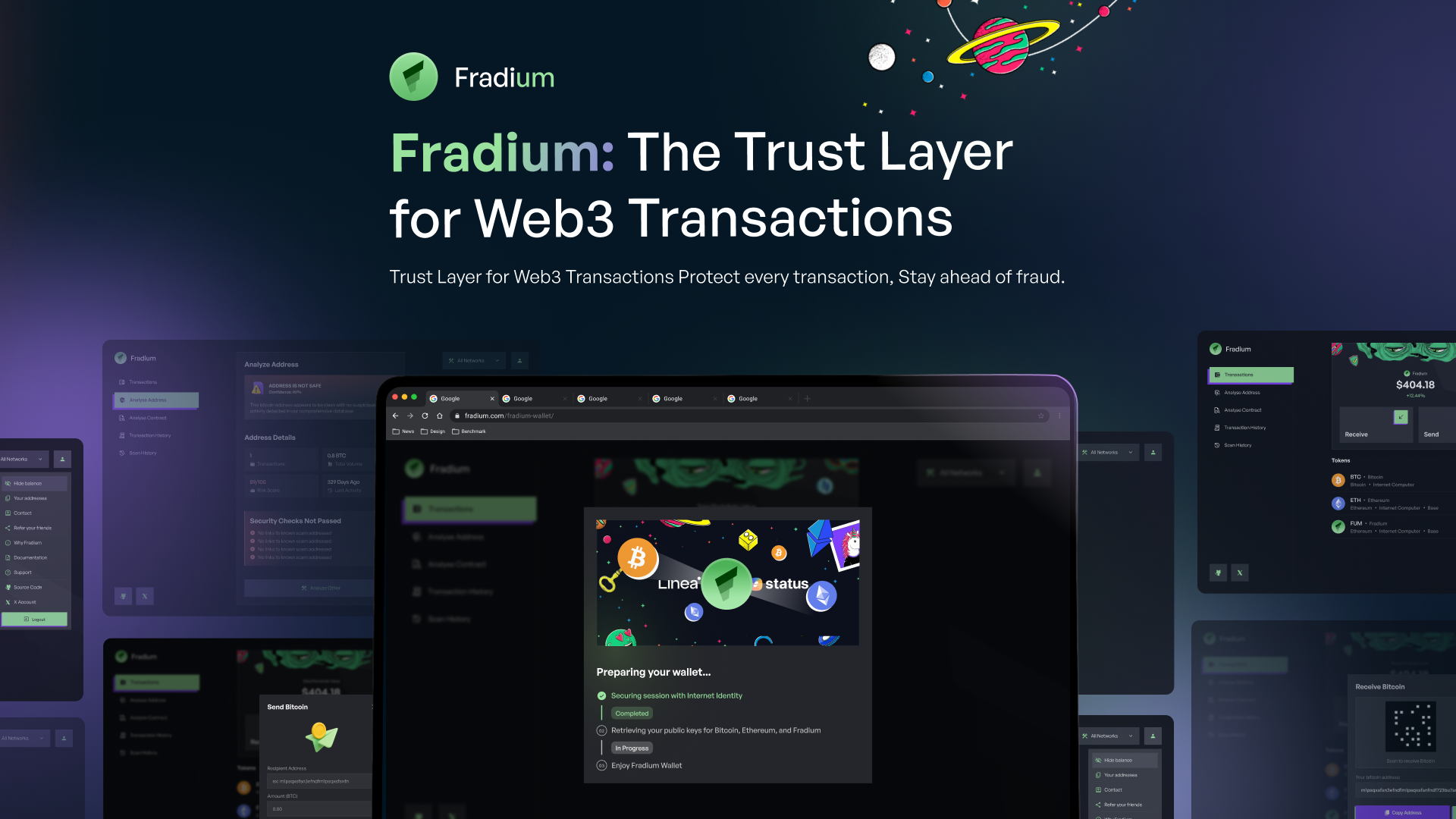


Fradium is a security and analytics platform built fully onchain and designed to work seamlessly across multiple blockchain networks including Bitcoin, Ethereum, Solana, Internet Computer, and others network., Fradium enables real-time address analysis, transaction insights, and threat detection across different ecosystems.
The platform provides a complete set of tools including a decentralized wallet app, browser extension, and community-driven reporting system. Users can analyze, report, and transact with greater confidence. Suspicious addresses are identified through AI models trained on high-quality datasets, and results are continuously improved through community contributions and verified reports. With token incentives and transparent voting, Fradium empowers users to actively participate in securing the Web3 space.
🌟 Built for WCHL 2025 Hackathon - View on DoraHacks
Fradium addresses urgent challenges in Web3 security and adoption:
- Despite ranking #3 globally in crypto adoption with 356% YoY growth, Crypto global scams reaching $2.5B in 2023, saw 332K wallet drainer victims, and over $40.9B was sent to illicit addresses.
- These risks are driven by low blockchain literacy and lack of awareness around smart contract and wallet vulnerabilities.
- Traditional wallets and explorers provide limited protection or context, leaving users exposed to phishing, scams, and malicious addresses.
Our solution introduces Fradium, a fully on-chain security and analytics platform that provides real-time address analysis, transaction insights, and AI-powered threat detection across multiple blockchains. With decentralized reporting, tokenized incentives, and transparent governance, Fradium empowers users to transact with confidence while actively contributing to securing the Web3 ecosystem.
- Mainnet: https://fradium.io
- 2-min Demo: https://youtu.be/4Twnw54thms
- 3-min Pitch: https://youtu.be/OrjROVReH6o
- Pitch Deck: Pitchdeck File
- Docs: https://fradium.gitbook.io/docs
- Extension Chrome store: Chrome store

Fradium Wallet is the all-in-one gateway to Web3 safety. Available as both a mobile/web app and browser extension, it provides seamless access to your assets and built-in AI protection.
- Manage multiple blockchain assets in one secure interface.
- Supports Bitcoin, Ethereum, Solana, and Internet Computer (ICP).
- Addresses are generated on-chain with verified identity binding.
- Real-time AI risk analysis before every transaction.
- View complete transaction history and scan logs across chains.
- Extension version provides instant address checks and safety alerts directly inside your browser.
A Web3 payment link that lets users send and receive crypto safely through a simple URL. Every transaction is verified by Fradium Analyzer, ensuring both sender and receiver are trustworthy.
- Generate unique payment links for instant transfers.
- Integrated AI address verification for both parties.
- Works seamlessly across supported blockchains.
A trustless on-chain escrow system for secure peer-to-peer trading. Funds are locked until both parties confirm, ensuring fairness and eliminating fraud.
- Safe trading without intermediaries.
- On-chain contract releases funds only when conditions are met.
- Perfect for OTC and P2P transactions.
Fradium’s AI engine continuously scans blockchain activities to detect anomalies, scams, and fraud in real time. It learns from both community feedback and on-chain data.
- Detects threats using evolving datasets.
- Analyzes address behaviors across multiple networks.
- Continuously retrained via on-chain AI learning and community input.
Fradium empowers users to shape a safer Web3 through community-driven intelligence.
- Report suspicious addresses with supporting evidence.
- Earn $FRADIUM tokens for credible contributions.
- Vote and stake in governance through Proof of Credible Contribution (PoCC).
- Transparent tracking of all contributions and reputation metrics.
The native utility and governance token powering the Fradium ecosystem.
- Used for staking, voting, and rewarding credible reports.
- Required for API access and developer integration.
- Fully on-chain with transparent tokenomics.
A public API for developers to integrate Fradium Analyzer directly into wallets, dApps, or exchanges.
- Embed real-time risk detection into your own platform.
- Authenticate via FRADIUM tokens for usage credits.
- Boost trust and safety for your Web3 users.
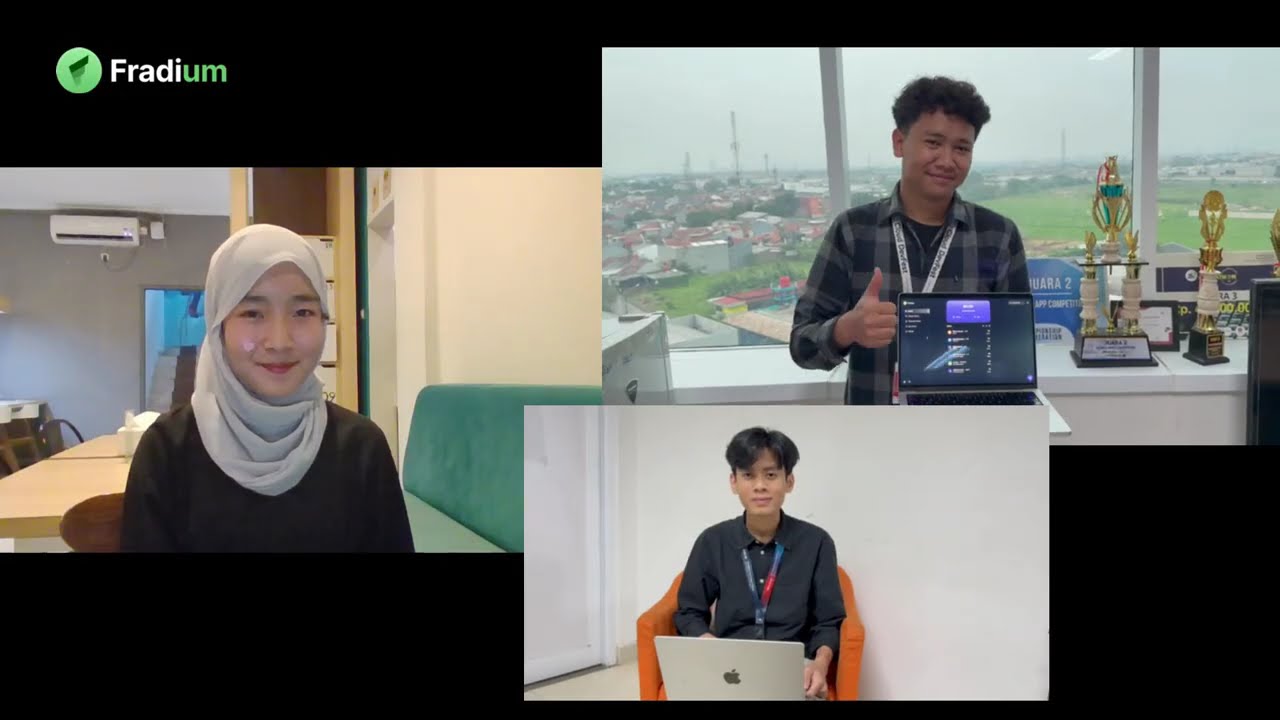
To ensure Fradium is not just powerful but also usable, we ran beta tests with real users, applying the System Usability Scale (SUS) framework. This gave us concrete feedback on clarity, efficiency, and user confidence.
  |
  |
|---|
 |
|---|
🎥 Above is a short video recap of the beta testing process and user feedback: Watch the video
-
Real-Time Address Analysis: Constantly analyzes blockchain addresses across multiple chains (Bitcoin, Ethereum, Solana, ICP) as transactions occur.
-
Advanced Feature Engineering: Extracts 100+ behavioral and transactional features, including:
- Transaction Patterns: Frequency, timing, and amount distributions of address activity.
- Network Relationships: Address clustering, interaction patterns, and connection analysis.
- Behavioral Signatures: UTXO spending patterns, smart contract interactions, and gas usage.
- Risk Indicators: Known scam patterns, suspicious activity flags, and anomaly detection.
-
Multi-Chain Intelligence: Builds comprehensive threat profiles by analyzing chain-specific behaviors and cross-chain patterns, modeling different attack vectors and fraud techniques.
-
Predictive Modeling: Uses Neural Networks (MLP) via ONNX to predict threat levels, highlighting the most influential features driving security assessments.
Our model has learned that the most critical predictors of malicious activity are:
- Transaction Clustering Patterns – How addresses group together and interact with known threat actors has the strongest impact on threat scoring.
- Behavioral Anomalies – Deviations from normal spending/interaction patterns significantly affect risk assessment.
- Network Position & Gas Usage – How addresses position themselves in the network and their resource consumption patterns.
- Temporal Analysis – Timing patterns, activity bursts, and coordination with other suspicious addresses.
Other factors such as transaction amounts, contract interactions, and validator patterns still contribute, but with less influence compared to the above.
| Technical Architecture | Model Performance |
|---|---|
| ML Framework | Neural Networks (MLP) via ONNX |
| Inference Engine | tract-onnx on Internet Computer |
| Model Training | Python (scikit-learn) |
| Deployment | Embedded ONNX models in Wasm canisters |
| Processing | On-chain inference for trustless predictions |
| Learning | Continuous improvement through community feedback |
- Bitcoin Detection: Analyzes UTXO patterns, transaction clustering, and spending behaviors
- Ethereum Detection: Examines smart contract interactions, ERC-20 token flows, and gas usage patterns
- Solana Detection: Evaluates program interactions, token account behaviors, and validator patterns
- ICP Detection: Monitors canister interaction patterns, cycles consumption behavior, principal authentication analysis, and inter-canister communication patterns
| Features Importance | Confusion Matrix |
|---|---|
 |
 |
| Precision Recall | True/False Positive | Training Loss |
|---|---|---|
 |
 |
 |
📖 For more details, see the technical explanation.
- Install the IC SDK v0.27.0. If the IC SDK is already installed with an old version, install 0.27.0 with
dfxvm. - Confirm the IC SDK has been installed with the correct version with
dfx --version. - Install candid-extractor
- On macOS, an
llvmversion that supports thewasm32-unknown-unknowntarget is required. This is because thezstdcrate (used, for example, to decodebase64+zstd-encoded responses from Solana'sgetAccountInfo) depends on LLVM during compilation. The default LLVM bundled with Xcode does not supportwasm32-unknown-unknown. To fix this, install the Homebrew version, usingbrew install llvm.
Begin by opening a terminal window.
Install the MOPS package manager, e.g., by running
curl -fsSL cli.mops.one/install.sh | shcurl https://sh.rustup.rs -sSf | shFradium includes Bitcoin functionality. For testing and development, you can run a local Bitcoin regtest instance, allowing you to mine blocks instantly, issue fake BTC, and test transfers securely.
To set up your local Bitcoin regtest environment, follow this official guide:
👉 Install bitcoin on local machine
The guide walks you through:
- Installing bitcoind
- Creating bitcoin.conf and bitcoin_data directory
- Running bitcoind
Once bitcoind is running successfully on your local machine, you can proceed to set up and deploy the application.
-
Start local Internet Computer replica
cd fradium/ dfx start --clean --background -
Deploy applications
dfx deploy
-
Run the script to mint Fradium tokens to the backend
 chmod +x ./scripts/fradium.mint_backend.sh
 ./script/fradium.mint_backend.sh
Fradium’s backend canister has been fully tested using PocketIC, a local in-memory Internet Computer emulator that ensures deterministic, reliable, and isolated testing before deployment.
All major canister modules have passed internal verification:
- Community Module: Validates basic canister functions and state transitions.
- Faucet Module: Ensures proper token distribution and cooldown logic.
- Staking & Rewards: Simulates reward distribution and staking flows end-to-end.
- Voting Mechanism: Confirms user authentication, voting logic, and data integrity.
- Comprehensive Suite: Skipped by design (mock file dependency).
Result: 28 tests passed successfully with 0 failures. 9 tests skipped intentionally.
To run the test suite locally:
# Setup Python virtual environment
python3 -m venv .venv
source .venv/bin/activate
pip install -r requirements.txt

# Start local Internet Computer
dfx start --clean --background

# Build canisters
dfx build

# Run tests
python -m unittest tests.test_community tests.test_faucet tests.test_staking_rewards tests.test_voting_mechanism -v
Expected output:
Ran 28 tests in XXs
OK
Fradium is built fully on-chain, combining multi-chain analytics, AI inference, and community governance into a seamless security layer for Web3. The architecture ensures every transaction is checked before execution, supported by AI models running inside Internet Computer canisters.
The high-level design of Fradium, showing how cross-chain data flows into the analytics engine, how AI models run on-chain, and how users interact via wallet, extension, and reporting modules.

Illustrates the journey of a user interacting with Fradium from scanning an address, receiving an AI-powered risk score, to community-driven reporting and DAO voting for validation.

This flow demonstrates how users can purchase Fradium tokens directly using fiat currency through Transak, a secure on-ramp provider.

- Chain fusion Technology: Unified integration with multiple blockchain networks, allowing address lookups, transaction insights, and security checks across different ecosystems from a single platform.
- AI On-Chain Address Analyzer: Advanced machine learning models trained on complex datasets of blockchain activity, converted into ONNX format and deployed directly on Internet Computer canisters for real-time, trustless threat detection.
- Fradium Wallet Extension: A browser-based companion tool that adds pre-send safety checks, risk explanations, and cross-chain token support, helping users stay safe while interacting with dApps, wallets, and explorers.
- LLM On-Chain Interaction: Large Language Model successfully deployed inside an ICP canister, enabling intelligent on-chain AI interaction without relying on off-chain servers.
- DAO-Driven Community Reporting & Voting: A fully on-chain governance system where users can report suspicious addresses, validate evidence, and participate in decentralized voting—forming a security-focused DAO that strengthens collective trust in Web3.
- Custom $FRADIUM Token: Native utility and governance token built with ICRC-1 and ICRC-2 standards, powering staking, voting, and rewarding credible community contributions.
Fradium’s development journey is divided into four key phases, each focused on building, testing, scaling, and expanding the ecosystem.
| Goal | Description |
|---|---|
| Build Product | Develop all core features and products in the target platform. |
| Integration with SNS | Integrate with decentralized networks for community governance. |
| On-chain Continuous AI Training | Strengthen Fradium’s detection model through real-time on-chain learning. |
| Goal | Description |
|---|---|
| Build Community | Foster ambassadors and early testers to drive organic adoption. |
| Custdev and Testnet | Engage users to test and provide feedback on the product. |
| University Outreach | Build a strong Web3 student community to onboard new crypto users. |
| Goal | Description |
|---|---|
| Token Listing Preparation | Announce token listing to build anticipation and awareness. |
| Marketing Hype | Run targeted KOL and campaign strategies to attract investors and users. |
| Partnership Expansion | Collaborate with ecosystem partners, launch early incentives, and cross-community promotions. |
| Goal | Description |
|---|---|
| CRM & Retention | Strengthen user loyalty through rewards, governance participation, and education programs. |
| Maintain Visibility | Continue engagement with updates, AMA sessions, and press releases. |
| Ride the Hype | Leverage post-TGE momentum to sustain user and investor interest. |
Distributed under the MIT License. See LICENSE.txt for more information.
- Wildan Syukri Niam (Frontend Developer)
- Bintang Al-Fath (Product Developer)
- Ghina Rosvita Maharani (UI/UX Designer)
- Arga Adolf Lumunon (AI Engineer)
- Yazid Al Ghozali (Extension Developer)