








I build small, sharp tools in the open — mostly terminal programs for watching AI coding agents work, pytest plugins that turn those sessions into CI assertions, plus a few projects that exist to make a number defensible instead of merely plausible.
Everything here is single-purpose and installable without a build step, mostly Apache 2.0 (a couple are still MIT — check each repo). Write-ups live at blog.swamplink.com.
I write code most days, and I build these on my own — so the failure mode is not running out of ideas, it is never having one argued with.
If you try something here, I would like to know where it broke, what you expected it to do instead, or why you closed it after thirty seconds. Every repo has Discussions open, and dev@swamplink.com reaches me directly.
Three sibling TUIs. They share a premise: once you are running more than a couple of agents at once, the expensive failures are the ones you cannot see — a session about to hit its context limit, two sessions quietly destroying each other's uncommitted work in the same checkout, a red build scrolling out of view. All three are read-only by construction and degrade to a labelled gap rather than an error when a data source is missing.
| what it answers | install | |
|---|---|---|
| roost | What are the models doing? Every live Claude Code session, its model, its context burn — and the subagents it spawned, which nothing that watches pids can see. | brew install gmhoward9289-ops/tap/roost · pipx install roost-top · npm i -g roost-top · winget install gmhoward9289-ops.roost · apt |
| leghorn | What did this agent actually do? A session reports intent; git reports what landed. Sessions joined to real git state, GitHub CI and open PRs with failures pinned until green, and a commit feed across every repo. | brew install gmhoward9289-ops/tap/leghorn · pipx install leghorn · npm i -g leghorn · apt |
| legbar | Both, on one canvas. Live agent sessions beside GitHub CI from a single discovery layer, so the two panes can never disagree. Sees Cursor agents too, which write no session marker at all. | brew install gmhoward9289-ops/tap/legbar · pipx install legbar · npm i -g legbar · apt |
| git-roost | What is actually in the trees? Every repo and worktree on the box in one table, most actionable first. Sessions report intent; git reports what happened. | brew install gmhoward9289-ops/tap/git-roost · pipx install git-roost · npm i -g git-roost |
Python 3.9+, macOS/Linux/Windows. Standard library only on macOS and Linux;
Windows pulls in windows-curses, because curses is the one thing not
already in the stdlib there.
Questions in the open go in Discussions: roost · leghorn · legbar · git-roost.
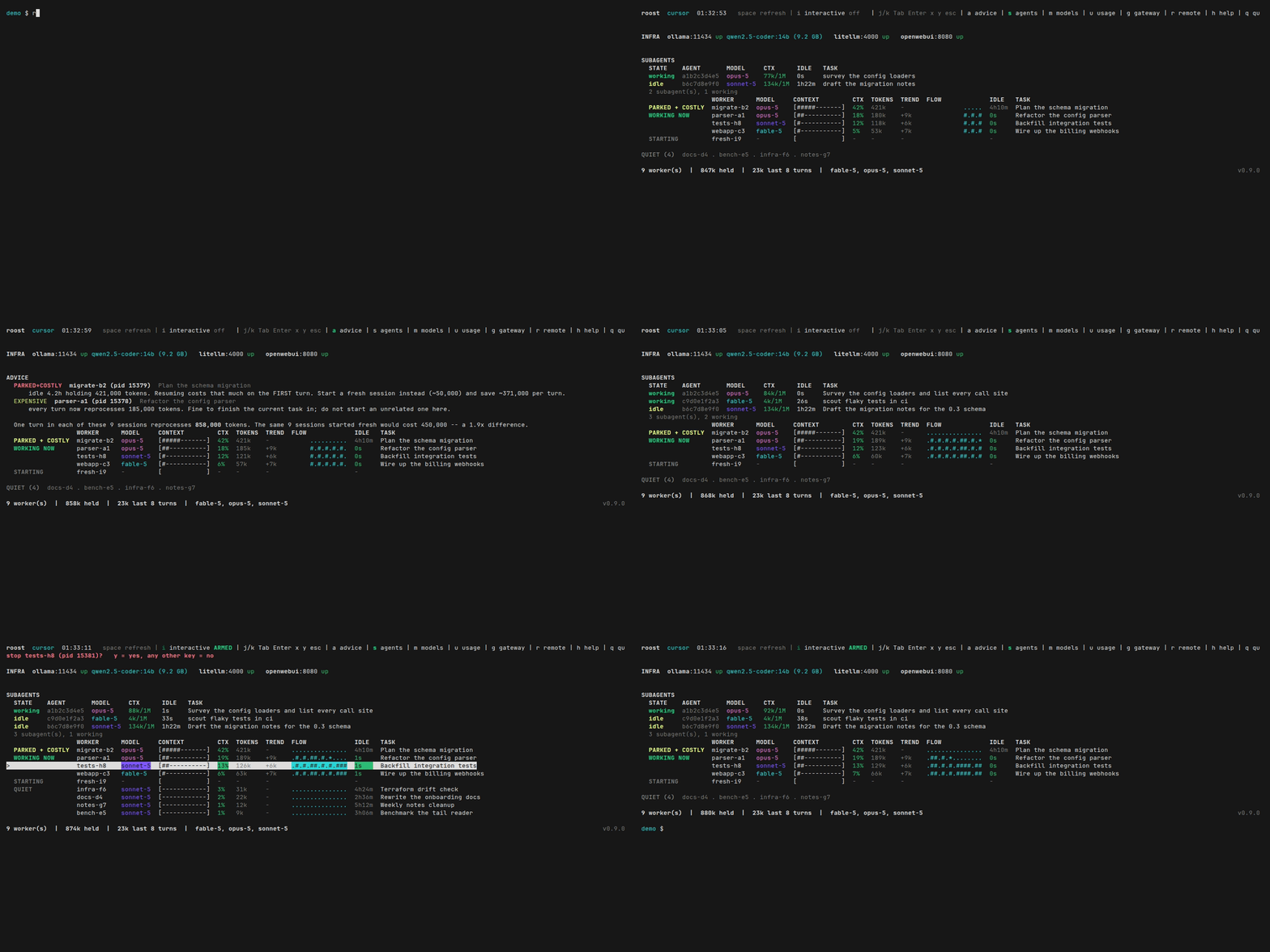
roost — buckets, subagents, the advice panel, and a cancelled stop.
The flock watches live. These three keep a typed record and assert against it in CI — no LLM in the pipeline, no network calls from the test.
- henhouse — Claude Code and Cursor JSONL transcripts parsed into typed session summaries and tool-call events. Stdlib only. The flock products link this schema; they do not take a pip dependency on it.
- pytest-session-trace — a recorded agent session becomes deterministic tool-call assertions. Point the fixture at a JSONL or henhouse envelope; CI fails when the calls do not match.
- pytest-mcp-contract — domain MCP tool contracts: registered names, annotations, input schemas, and in-memory handler calls. Not protocol conformance, not security payloads.
Together: contract says the server exposes the right tools; session-trace says a saved run actually called them. Starter stack:
pytest-mcp-contract/examples/proof_stack/.
Discussions: henhouse · pytest-session-trace · pytest-mcp-contract.
- counting-chicken-wings — how many chickens does it take to make a dozen wings? Six is a floor, not a fact; the real answer is usually close to twelve. A pooling model with an honest uncertainty band, where every input cites a primary source.
- xycalc — how much X does it take to run Y? Infrastructure sizing from a corpus where every number cites a source and names the versions it applies to.
- apcam-ai-power-meter — APCAM. What local LLM inference actually costs in electricity, from measured GPU wattage rather than a spec sheet.
- trust-but-anchor — models misquote sources 27–36% of the time even when told to be verbatim. Letting code locate a model-proposed anchor instead of trusting its quote recovers near-total coverage, with every span a real substring by construction.
- counting-makeup-foundation — sourced research on the cosmetics industry, at foundation.swamplink.com.
- llm-security-rules — tested Semgrep rules for LLM application security, mapped to the OWASP Top 10 for LLM Applications (2025). Every rule ships with the code that should trip it and the code that should not.
- awesome-tuis — a curated list of terminal user interface projects.
Built in a Digital Swamp. Contact: dev@swamplink.com
From my swamp to yours.