Proof of Concept (PoC) implementation of the Model Context Protocol (MCP) using Rust,
applied in an IT Operations scenario for the Singapore Mass Rapid Transportation (SMRT) system.
This project is for demonstration & educational purposes only.
I am not affiliated with the IT Department of SMRT.
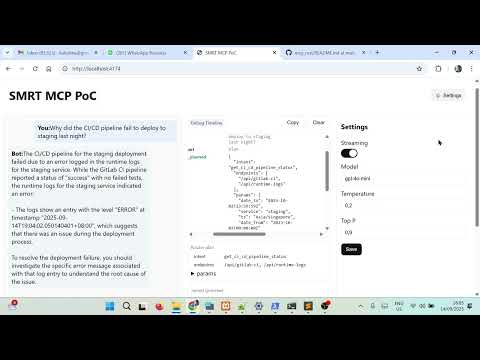
Model Context Protocol (MCP) is a standard for connecting AI assistants to external tools, data sources, and APIs.
Instead of hardcoding application logic or asking users to memorize commands, MCP enables an AI-driven intent router that:
- Accepts natural language queries from users.
- Uses an AI model (OpenAI Responses API with JSON Schema) to detect the intent.
- Maps the intent to one or more API endpoints.
- Fetches and optionally joins data from those endpoints.
- Returns results to the AI for human-readable answers in the chat interface.
💡 Example:
User: “Did the last GitLab CI job for the main branch succeed or fail?”
- MCP Router detects intent =
ci_status. - Routes to
/api/gitlab-ci. - Fetches dummy JSON with job status + failed tests.
- AI composes a clear answer for the user.
👉 With MCP, developers don’t have to build custom logic for each question. Instead, MCP bridges user intent ↔ system APIs in a structured, scalable way.
- 🦀 Backend: Rust (Axum, SQLx, Reqwest, SSE)
- ⚡ Frontend: Vue 3 + Vite + TypeScript
- 🗄️ Database: MySQL 8
- 🐳 Infrastructure: Docker & Docker Compose
- 🤖 AI: OpenAI GPT (Responses API + JSON Schema)
sequenceDiagram
    autonumber
    participant U as User
    participant F as ChatPanel (Vue 3)
    participant B as Backend (Rust/Axum)
    participant R as MCP Router
    participant O as OpenAI (Intent)
    participant E as API Endpoints (dummy)
    participant DB as MySQL

    U->>F: Ask question (natural language)
    F->>B: POST /api/chat (or /api/chat/stream)
    B->>R: Hand off to MCP Router
    R->>O: Intent detection (Responses API + JSON Schema)
    O-->>R: Intent + routing plan
    R->>E: Fetch data from mapped endpoint(s)
    E-->>R: JSON payload(s)
    R->>DB: (Optional) persist/query cached results
    DB-->>R: Data rows (if any)
    R-->>B: Joined + normalized result
    B-->>F: SSE stream (phases)
    F-->>U: Render answer
🌀 SSE Debug Phases:
received → llm_start → route_planned → fetch_progress → joined → done
- Frontend (Vue 3 + Vite + TS) — ChatPanel UI, SSE streaming, status chips.
- Backend (Rust/Axum) — HTTP API, SSE handler, tracing, error handling.
- MCP Router (Rust module) — Prompt Builder → Intent Classifier → Endpoint Planner → Joiner.
- AI (OpenAI GPT) — Intent detection with JSON Schema output.
- Data Sources (Dummy Endpoints) —
/api/gitlab-ci,/api/runtime-logs,/api/observability, etc. - Database (MySQL 8) — Config & optional cache.
- Infra (Docker & Compose) — Reproducible local stack.
- User asks in ChatPanel →
POST /api/chat. - Backend forwards to MCP Router.
- MCP calls OpenAI to get intent & routing plan.
- MCP fetches from mapped endpoint(s), optionally consults MySQL.
- MCP normalizes/joins → Backend streams via SSE → UI renders phases & final answer.
flowchart TD
  subgraph Client
    U[User] --> F["ChatPanel (Vue 3 + Vite)"]
  end

  subgraph Server["Rust Backend (Axum)"]
    DB[(MySQL 8)]

    F -->|HTTP/SSE| B["API Gateway & SSE Handler"]
    B --> R["MCP Router\n(Prompt Builder • Intent Classifier • Joiner)"]
    R -->|JSON Schema| O["OpenAI Responses API"]

    R --> E1["/api/gitlab-ci/"]
    R --> E2["/api/runtime-logs/"]
    R --> E3["/api/observability/"]
    R --> E4["/api/security-auth/"]
    R --> E5["/api/incident-metrics/"]

    R <-- DB
    B --> DB
  end

  O -.-> R
  E1 -. JSON .-> R
  E2 -. JSON .-> R
  E3 -. JSON .-> R
  E4 -. JSON .-> R
  E5 -. JSON .-> R

  R -->|Normalized Result| B
  B -->|SSE Stream| F
  F --> U
settings— key/value app configuration.api_results— simple cache of API responses.users/sessions— for JWT-based auth (future).
| # | Question | Intent | Endpoint(s) |
|---|---|---|---|
| 1 | Why did the CI/CD pipeline fail to deploy to staging last night? | ci_root_cause |
/api/gitlab-ci, /api/deployments |
| 2 | Can you show me the latest runtime logs for the payments service? | logs_fetch |
/api/runtime-logs |
| 3 | How many unresolved tickets are in the observability dashboard right now? | observability_ticket_count |
/api/observability |
| 4 | Did the last GitLab CI job for the main branch succeed or fail? | ci_status |
/api/gitlab-ci |
| 5 | What is the current error rate in the production API gateway? | error_rate |
/api/observability |
| 6 | Can you compare the deployment duration between staging and production for the last 3 releases? | deploy_duration_compare |
/api/deployments, /api/releases |
| 7 | Show me the container logs for the auth-service during yesterday’s deployment. | logs_during_window |
/api/runtime-logs, /api/deployments |
| 8 | Which microservice caused the rollback in last night’s release? | rollback_root_cause |
/api/releases, /api/deployments, /api/runtime-logs |
| 9 | List all failed test cases from the last CI run. | ci_failed_tests |
/api/gitlab-ci |
| 10 | What is the average response time for the orders API in the past 24 hours? | latency_avg |
/api/observability |
- 🔗 Plug Grafana/Prometheus for real metrics.
- ⚡ Add rate limits & circuit breakers per endpoint.
- 📝 Persist audit logs for prompt, intent, and endpoint calls.
- 🐞 Expose /internal/debug for tracing intent & routing.
Kukuh Tripamungkas Wicaksono (Kukuh TW) 💻 Software Architect
- 📧 Email: kukuhtw@gmail.com
- 📱 WhatsApp: wa.me/628129893706
- 🔗 LinkedIn: linkedin.com/in/kukuhtw
- 🐙 GitHub: github.com/kukuhtw
---