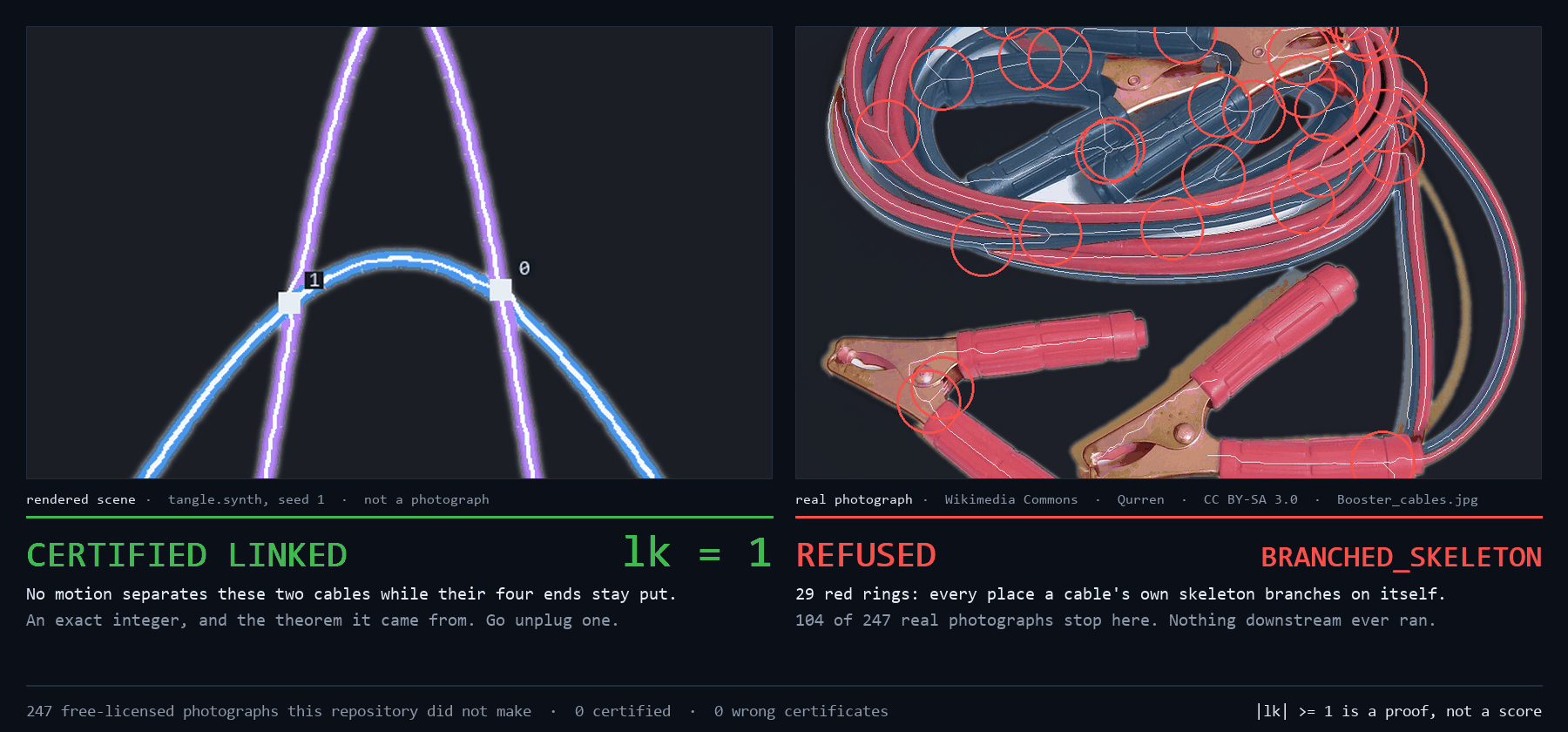
Two cables in one picture: it proves they cannot be pulled apart, or it refuses and names the crossing to re-shoot. It never guesses.
Invented by Teerth Sharma · teerths57@gmail.com · github.com/teerthsharma/tangle · RESULTS.md
pip install tanglekit                              # the import and the command stay: tangle
tangle --synthetic --seed 2 --overlay verdict.png  # renders a scene, reads it, prints a verdict
0 wrong certificates — over 2,000 rendered diagrams, 80 rendered scenes and 247 real
photographs, on which it also returned 0 certificates at all. Both numbers are below.


Two cables are wound around each other behind your desk. Before you start pulling you want to know one thing: are they actually locked, or do they only look bad? Pull on a genuinely locked pair and you tighten it into a worse knot.
tangle looks at a picture of the two cables and answers that — or tells you it cannot see well
enough, and where to stand for a better shot. No maybe, no percentage: a yes with a proof behind it,
or a refusal with a reason.
Where it actually works today. It answers on pictures it renders itself. Point it at a real photograph and, so far, it says "cannot see" every single time — 247 times out of 247. For 104 of those 247 the reason is the same one, and fixing it is the next thing being built. Nothing here hides that: it is in the hero, in a badge, and measured in Benchmarks.
- It finds the two cables in the picture and separates them from the background (segmentation).
- It thins each cable down to a single line running along its middle (skeletonisation), and every place those two lines touch is a crossing.
- At each crossing it works out which cable is on top, by seeing whose outline the other one interrupted — the one that got covered up is underneath (occlusion continuity).
- Crossings that twist one way count as plus one, the other way minus one; it adds them all up and halves the total (the Gauss linking number).
- If that total is not zero, the two cables are genuinely locked together and no amount of pulling will separate them, so go unplug one.
- Where the picture is too blurry to tell who is on top, it works out the answer for both possibilities at once, and if those answers disagree about whether the total is zero, it says so instead of picking one.
Refusing is a real answer here, not a crash. It has its own exit code, its own reason, and its own instruction. Five things make it refuse:
| it says | because the picture | what you do |
|---|---|---|
NOT_TWO_COMPONENTS |
has only one colour of cable in it, or two too close to tell apart | photograph two cables of different colours |
BRANCHED_SKELETON |
shows a cable crossing over itself, or two cables touching and merging into one shape | separate them, or re-shoot so they do not overlap themselves |
NO_INTENSITY_GAP |
does not separate cable from background clearly enough | more light, or a plainer surface underneath |
OPEN_TRACE |
shows a cable that neither runs out of the frame nor comes back to itself | pull back so both ends leave the picture |
LK_STRADDLES_ZERO |
is readable, but one crossing is too unclear to call, and that one crossing decides the answer | re-shoot the one crossing it names, from the bearing it gives |
Only the last of those is a refusal after the maths ran, and it is the one that tells you where to stand:
REFUSED  LK_STRADDLES_ZERO
look at  crossing 1 at 275,279, camera bearing 152 deg
advice   the achievable interval [0, 1] contains 0
The other four stop before any maths happens at all. On real photographs, all 247 refusals were of that earlier kind — the picture never became a diagram.
A refusal costs you a second photograph. A wrong certificate tells somebody to leave a live cable plugged in. That asymmetry is why the tool is built to refuse.
The invariant. Sum the signs of the crossings between the two cables, and halve it:
Here t_a and t_b are the directions the two cables are travelling at that crossing, measured in
the plane of the photograph. Their determinant needs no depth information at all; the only thing that
needs depth is x_c, the ±1 for who is on top.
That integer is an isotopy invariant. Bend the cables, drape them, re-route them, walk round and
shoot from the other side — as long as the four ends stay pinned where they leave the picture, lk
does not move. It is camera-angle invariant by theorem, which is exactly the property a network
trained on rope photographs does not have.
The unknowns. Both factors of ε(c) are ±1, so lk is affine in every crossing the
photograph could not read. With S the signed sum over the readable inter-cable crossings and k
unreadable ones, the set of linking numbers achievable over all 2^k ways of resolving them is
exactly k+1 consecutive integers:
Computed in O(k). No enumeration. No sampling. No posterior. Certification is lk_min > 0 or
lk_max < 0, and since the interval is contiguous with step 1, those two plus "straddles zero" are
exhaustive — there is no fourth case hiding.
![Two rows of crossing glyphs on one shared number line. Top: four read crossings plus two unknown give S = 2, k = 2, and the interval [0, 2], which the zero bar cuts through, so REFUSED. Bottom: six read crossings give S = 4, k = 0, and the single point 2, clear of zero, so CERTIFIED LINKED.](https://raw.githubusercontent.com/teerthsharma/tangle/main/assets/mechanism.png)
This is an interval certificate, not a confidence score. Flipping the over/under at any crossing
of a plane diagram always yields another diagram that a real pair of cables could form, so the 2^k
orbit is the exact set of tangles consistent with what the camera saw.
That is an exact set, not a heuristic superset and not a sample. Checked against explicit 2^k
enumeration: 0/1000 patterns disagree, over 192,540 enumerated lifts.
Explainable, minus the AI. The output is an integer, the crossings it came from, the theorem it came from, and a SHA-1 digest of the diagram it came from. Nothing is learned, nothing is fitted, nothing is a black box. Run it twice, get the same integer.
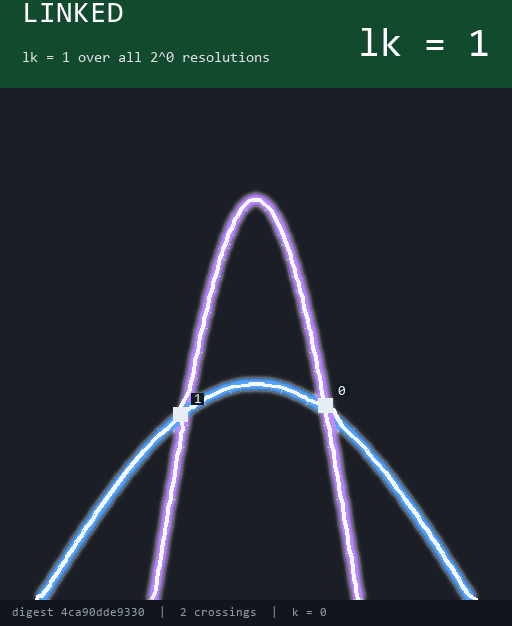
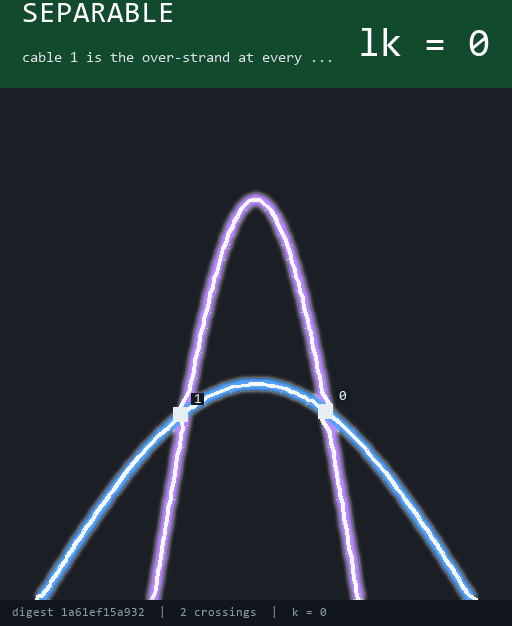
![Verdict card: REFUSED, interval [0,1], look at crossing 1](https://raw.githubusercontent.com/teerthsharma/tangle/main/assets/pile-refuse.png)
The certificate is one-directional. This is the part everyone gets backwards.
| verdict | when | what it means | exit |
|---|---|---|---|
| ✅ CERTIFIED LINKED | the interval excludes zero | Proved. No motion separates these cables with their ends held. Unplug one. | 0 |
| ✅ CERTIFIED SEPARABLE | one cable is on top at every crossing between them | Proved, by a different and independently sufficient witness. Just pull. | 0 |
| 🟡 NOT CERTIFIED | lk = 0, or both cables are on top somewhere |
The computation succeeded and proves nothing | 1 |
| 🛑 REFUSED | the interval straddles zero, or the trace is defective | The computation declined, with a cause and a next action | 2 |
| ⚫ BAD INPUT | the file cannot be read, or the flags do not parse | Not a verdict — the tool never ran | 3 |
lk = 0 is never "unlinked". The Whitehead link has lk = 0 and does not come apart. The word
unlinked is a banned substring inside this package, enforced by a test that greps the source and
every verdict the example set can produce. SEPARABLE is reachable only from the over-everywhere
witness, never from a zero linking number.
There is one more refusal the table above does not need but the code has: ODD_CROSSING_PARITY, a
parity theorem that catches every odd-cardinality tracer error, for free, with probability 1.
Every block below is pasted from the command above it. No number in this repository is hand-typed. Full tables, every control, and every arm that lost.
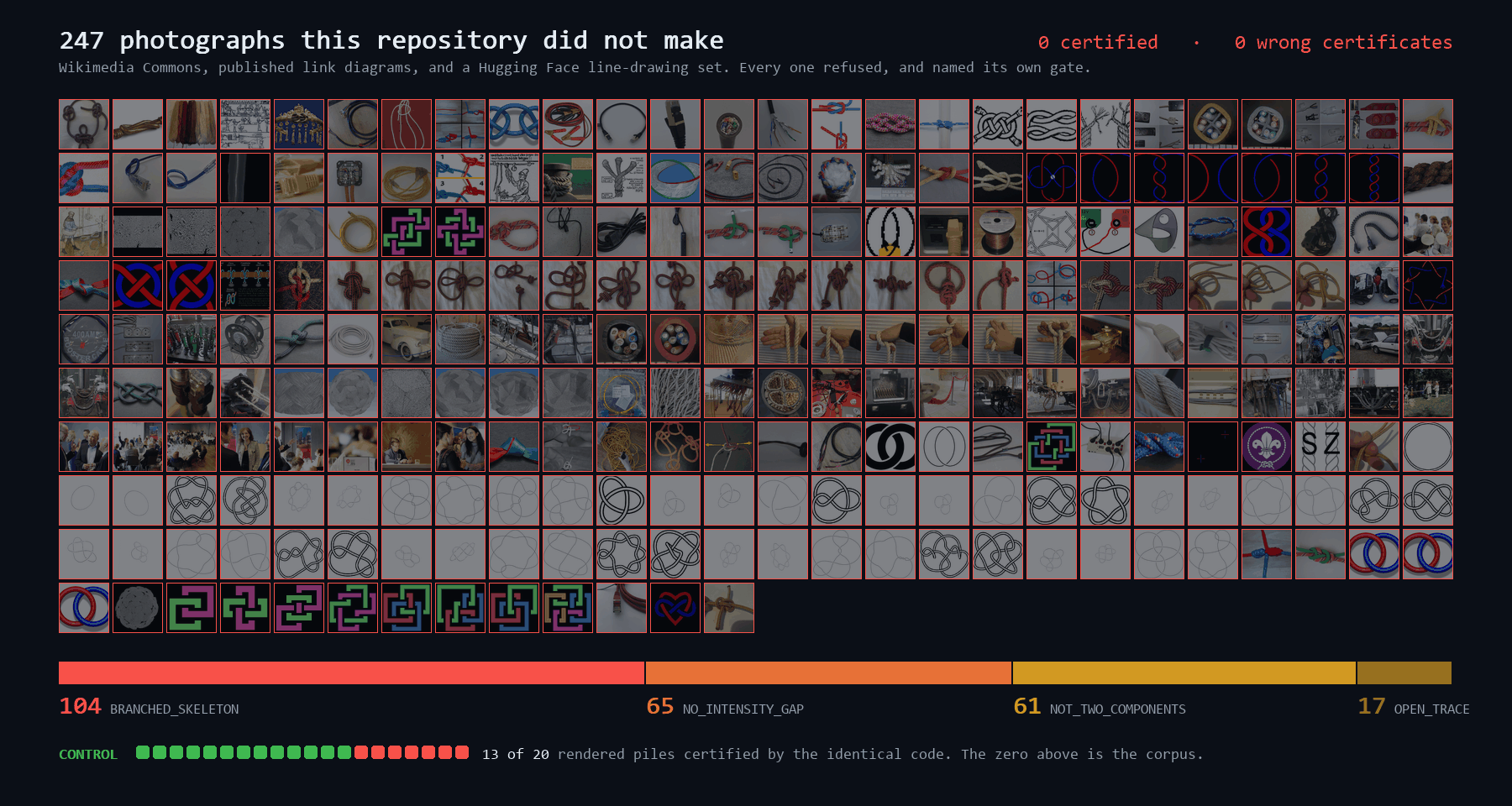
The one section whose input came from somewhere else. 99 knot photographs and 72 cabling photographs
from Wikimedia Commons, 27 published link diagrams, and 49 single-curve line drawings from
tr33hugg3r/knot-crossings on Hugging Face — all free-licensed, all pinned by sha256 in
photos/manifest.json, 51 MB.
.venv/Scripts/python real.py fetch --dir photos
.venv/Scripts/python real.py run   --dir photos

certified verdicts                  0   of 247
wrong certificates                  0   of  19 labelled
diagrams built at all               0   of 247
Not one real image reached certify(). Every one was stopped by a tracer precondition, before any
diagram existed:
| refusal | n | what it means about the picture |
|---|---|---|
BRANCHED_SKELETON |
104 | a cable's own centreline forks: it crosses itself, or two strands merged into one blob |
NO_INTENSITY_GAP |
65 | the two brightness classes of cable-ness separate by F < 2.0 |
NOT_TWO_COMPONENTS |
61 | one colour cluster, or two inside a just-noticeable difference of each other |
OPEN_TRACE |
17 | the arcs do not chain into one curve, edge to edge or back to the start |
The control that makes that zero readable. real.py control renders 20 scenes, writes them to
PNG, and reads them back through the identical code path — same resize, same alpha handling, same
one():
.venv/Scripts/python real.py control

synthetic control   n = 20
  CERTIFIED          13    65.0%
  REFUSED             7    35.0%
13 of 20 through the harness, 0 of 247 through the same harness on real input. The harness is not what is failing; the corpus is outside the envelope.
Against numbers published outside this repository. 19 of the 27 link diagrams carry a linking number nobody here wrote — 3 from the Thistlethwaite link table, 10 from standard facts about torus and Whitehead links, 6 written into the filename by an uploader who has never heard of this tool:
right 0 WRONG 0 no verdict 19
The only column that could have been a disaster is WRONG, and it is empty because the tool never
answered. → RESULTS.md §4
These come from
tangle.synth: matte constant-colour cables, no contact shadow, no specular highlight, no JPEG, no lens. None of it has been confirmed by a real photograph. It is stated separately from the section above for exactly that reason.
The headline claim. Not "tangle is accurate". The claim is that the O(k) interval certifies
strictly more pairs than refusing on any unknown crossing does, at the same zero error rate.
The baseline it is measured against is four lines of code: if any crossing is unreadable, refuse; otherwise take the half-sum. That baseline also scores zero errors, so the gap between the two rows is the only thing here that could have come out badly.
.venv/Scripts/python bench.py

==============================================================================
  certified pairs, at 0 wrong certified verdicts
  400 braid seeds x k = 0..4 blurred crossings = 2000 entries
==============================================================================
    tangle                                 23.6%   0 wrong (<=0.6% of certified at 95%)
    abstain on any unknown crossing        13.2%   0 wrong (<=1.1% of certified at 95%)
    ------------------------------------------------
    coverage gained by the interval theorem  10.3   points

  same diagrams, decision rule replaced:
    coin flip on unknowns                  70.3%   755 wrong
==============================================================================
    tangle CERTIFIED                       23.6%
    tangle NOT CERTIFIED                    6.2%
    tangle REFUSED                         70.2%
==============================================================================
  active perception -- the ranking is a perception heuristic, and theory
  predicts no gap: every unknown shrinks the interval width by exactly 1.
    named crossing re-shot, then certified 19.9%   of 1404
    random crossing re-shot, same budget   20.0%   control
==============================================================================
  k among certified verdicts -- if this is 0 almost everywhere, then
  "certified over all 2^k resolutions" is doing less work than it sounds.
    k=0: 276  k=1: 147  k=2: 49
==============================================================================
  the REFUSED rate above is a function of the blur schedule -- up to
  k = 4 of 6 crossings erased on purpose -- and is NOT a photograph's
  refuse rate.  That number needs the tracer and is not measured here.
------------------------------------------------------------------------------
  not run here: the R2-drape alternation control and the mask-overlap
  control need rendered scenes; every real-photograph table needs the tracer.
==============================================================================
  commit ac84ca0   machine WIN-16QAL06O9GB   python 3.11.9   0.29 s
==============================================================================
Ground truth is not the package's own arithmetic. Every entry is a closed braid word, and lk is
half the signed exponent sum over the inter-cable letters — known in closed form before any code
runs. → RESULTS.md §1
Picture to verdict, on rendered scenes. 20 seeded piles × 4 nuisance arms = 80 scenes. Truth is the scene's own height functions, so this scores the reader against the scene rather than against itself.
.venv/Scripts/python -m pytest -q -s tests/test_vision.py

  over/under on accepted crossings
    clean           46/ 46  100.0%
    blur 1.0 px     47/ 47  100.0%
    blur 3.0 px     44/ 44  100.0%
    antialiased     45/ 45  100.0%

  certified / wrong / refused, out of 20 piles per arm
    clean           16     0     4   (80.0% certified)
    blur 1.0 px     17     0     3   (85.0% certified)
    blur 3.0 px     16     0     4   (80.0% certified)
    antialiased     14     0     6   (70.0% certified)
    rule of three: 0 wrong in 63 certified is an upper bound of 0.048, not a rate of 0
    unknown crossings among certified verdicts: {0: 63}

  coin flip on the identical diagrams, seed 20260905
    clean          read  16 certified / 0 wrong    coin  19 certified / 11 wrong
    blur 1.0 px    read  17 certified / 0 wrong    coin  18 certified / 12 wrong
    blur 3.0 px    read  16 certified / 0 wrong    coin  17 certified / 13 wrong
    antialiased    read  14 certified / 0 wrong    coin  19 certified / 11 wrong
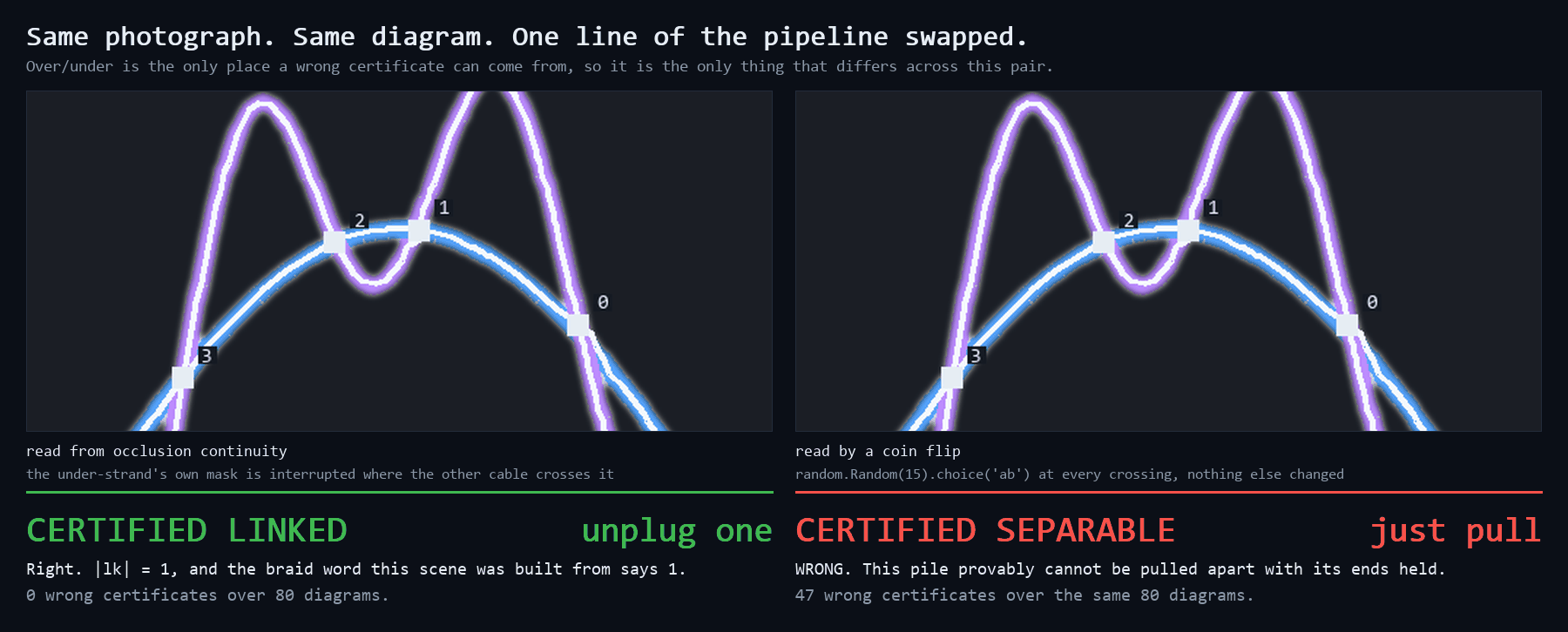
Same extracted diagrams, over/under reader swapped for a coin flip: 47 wrong certificates against 0. The corpus is not too easy — a guesser fails loudly on it. → RESULTS.md §3
python -m venv .venv && . .venv/*/activate   # .venv\Scripts\activate on Windows
pip install -e ".[test]"
pytest -q                # 226 passed, 2 skipped
pytest -q -s             # the same run, with the tables above printed
python bench.py          # the coverage table
python real.py fetch --dir photos && python real.py run --dir photos && python real.py control
tangle is zero-shot: no training, no neural network, no dataset, no GPU. Just numpy, scipy,
scikit-image, pillow and a theorem from 1833. The certified layer turns out 2,000 verdicts in
0.29-0.31 s on a laptop CPU, over three runs. The imaging layer is not timed yet.
Nothing in the certified layer is new. Saying so first is what makes the rest believable.
| work | what they have that this does not | what tangle adds |
|---|---|---|
| Matsuno et al. 2006 (TMECH) | the pipeline itself: photo → topological rope model → knot invariant → verdict, published in 2006 | an explicit UNKNOWN state, certification over the achievable interval, refusal that names a crossing, open code |
| KnotDLO (arXiv:2506.22176) | it acts — ties knots on real hardware, 50% on overhand from unseen configurations | an invariant, a hard certificate, and a calibrated abstention |
| Knots-10 (arXiv:2603.23286) | real rope photographs at scale, and a 58–69 pp accuracy collapse from studio images to phone photos | an invariant that is material-, colour- and viewpoint-independent by construction |
| HANDLOOM (arXiv:2303.08975) | a learned cable tracer that is better than this one, on real RGB-D images | an exact integer downstream of the trace, and a refusal when the trace is not good enough |
| pyknotid / Spherogram / SnapPy (repo) | every invariant here, computed better and more generally — the third-party control this repo owes them | the image half, which is where 100% of the risk lives |
Two honesty notes. Matsuno's paper is paywalled and has not been read here, so if either of their
invariants turns out to be the linking number, the novelty scopes down to the unknown-crossing orbit,
the pinned ends, and the refusal. And tangle must not claim to beat the Knots-10 studio-to-phone
collapse until it has been run on their images, which it has not.
Also standing on Gauss 1833 (the linking integral and the half-sum), Goeritz 1933 and
Gordon–Litherland 1978 (det(L) = |Δ(−1)|), Habegger–Lin 1990 (string links), and Lui &
Saxena 2013, who did the ambiguity orbit as a particle-filter posterior. The one real difference
from them is exactness and one-sidedness: a hard certificate plus an abstention, instead of a
posterior plus a threshold.
Six design verdicts that are now dead, and two arms that lost after they shipped.
- "
lk = 0means just pull." The Whitehead link. Killed, and the word unlinked is banned in code. - "Closing the diagram at the frame boundary makes
lkcamera-invariant." It does not: the exit points move with the camera, and an exterior crossing's over/under is a convention that does not flip when its planar sign does. The closure was deleted. The object is a 2-string tangle with pinned ends, which needs no closure at all. - "A width bump at the crossing reads over/under." For opaque cables the silhouette is provably depth-blind — the mask is bitwise identical under swapping which cable is on top. The cue carried zero information and was reading the renderer's drop shadow. There is now a test called
test_silhouette_carries_no_depth. - "A contraction radius fixed in cable widths merges the skeleton's H-pattern." It cannot: the bridge of an H at crossing angle θ is about
w / sin θlong, so a constant radius always loses the shallow crossings. Replaced by an angle-aware admissibility rule (vision.BRIDGE_K). - "
det = 5certifies a figure-eight tie-in." A follow-through is tied on a bight, so the doubled rope bounds a band and the traced curve is the unknot,det = 1. That is why climbing, rigging and every load-bearing verdict are out of scope: the determinant is computed, but no code path turns one into a knot name. - "Threshold at the widest empty gap in the histogram." That rule is satisfiable only by a renderer. A rendered cable is a flat stroke on a flat field, so its histogram is two spikes with nothing between; a photograph's is dense in every bin, because antialiasing, shading and depth of field put real pixels everywhere. Measured on the same 247 real images, the old rule admitted 97 and the Otsu-plus-Fisher rule that replaced it admits 182 (21 against 106 of the 171 photographs). It also widened the synthetic noise envelope from
σ = 6/255toσ = 16/255, with 0 unsound certificates across a 7-level, 20-pile sweep. - Active perception lost to random. Re-shooting the crossing the tool names: 19.9% certified. Re-shooting a uniformly random crossing at the same photograph budget: 20.0%. This was predicted before it was measured —
lkis affine, so every unknown shrinks the interval by exactly 1 and no crossing is more decisive than any other. The|sin θ|ranking is a perception heuristic, not an information criterion.bench.pyprints it; it is not buried. - On rendered scenes the interval theorem certified nothing the plain half-sum would not have. All 63 certified verdicts across four nuisance arms had
k = 0. The 10.3-point coverage gap exists on the braid corpus, where the unknowns are injected on purpose.
Collected once, here.
- It has been run on real images and it certified none of them. 247 free-licensed images produce 0 certified verdicts, 0 wrong certificates, and 0 diagrams built at all. The same harness certifies 13 of 20 rendered piles through the same PNG round trip, so the zero is the corpus, not the plumbing.
- Two visually distinct cables, or it refuses. Colour does the segmentation, so a pile of identical black charging cables is one mask and
NOT_TWO_COMPONENTS— 0 of 80 rendered scenes on the current segmentation gate, and 61 of 247 real ones. The most common real scene is the worst case. - Self-crossings are refused, not handled.
BRANCHED_SKELETONon 0 of 80 rendered scenes on the current gate and 104 of 247 real ones. On a real pile most crossings are self-crossings, which makes this the single largest limit on the imaging layer, and the dominant reason the real number is zero. - Noise is a cliff, not a slope.
σ = 16/255traces 10/10 piles;σ = 26/255traces 0/10. The failure direction is always a refusal, never a wrong certificate, and 20 piles at each of 7 noise levels produce 0 certificates the scene contradicts. - All four nuisance arms clear the 40% refuse gate. clean refuses 20%, blur 1.0 px 15%, blur 3.0 px 20%, antialiased 30% — highest is antialiased, still under the gate.
- Every benchmark percentage on this page except the real-image table comes from
tangle.synth. Coverage, the 182 of 182 crossings read the right way round, the 47 wrong certificates the coin flip buys,TAU,BRIDGE_K, the blur and antialiasing arms, closed-cable tracing, and every asset. The invariant layer is the one exception, and it is checked against closed forms rather than pictures. - No camera model, so no viewpoint-agreement measurement. Invariance is tested as diagram-move invariance (R1/R2/R3), which is strictly weaker than camera invariance. The two-view interval intersection exists and is unwired.
- The rendered corpus cannot exhibit
|lk| ≥ 2. An arch weaving across an arch cannot wrap twice;|lk| ≥ 2lives only in theT(2,n)family, which never goes through a camera. - An even number of tracer errors is uncaught and can produce a confidently wrong certified integer. Parity catches odd counts; nothing single-view catches pairs. This is the live false-certification path, stated here rather than discovered in a bench → RESULTS.md §7.
- The certificate answers a narrower question than you will ask. "Cannot be separated with the ends held" is not "will be annoying to untangle". An
lk = 0pile can still be a nightmare of friction. - Only
|lk|is certified; the sign is a stated convention. Image coordinates are y-down throughout, which negates every crossing sign relative to the y-up mathematical convention. - Never claimed, in any code path or string: unlinked from
lk = 0; unknotted fromdet = 1; a knot name from any determinant; chirality; a probability, confidence or percentage attached to a verdict; any climbing, rigging or safety verdict; anything at all about the cables outside the frame.
- Resolve a forked centreline instead of refusing on it. By continuing each cable's direction through the junction, with a decisiveness margin so an ambiguous blob still refuses. This is the one gate that would move the real-image number off zero: it is 104 of the 247 refusals, and nothing downstream of it has ever seen a real picture.
- More real photographs. Knots-10 (arXiv:2603.23286) and HANDLOOM's annotated RGB-D cable traces are downloadable and need no camera.
real.pyalready prints the refuse rate and the refusal-reason histogram, which is what ships before any accuracy claim. - Phone. The certified layer is integer arithmetic with no dependencies — WebAssembly, then a camera app that refuses out loud and tells you where to stand.
- Multi-view.
certify.intersectalready intersects two views' intervals, and disjoint intervals prove one trace is wrong. It needs a camera model before it is worth wiring up. - The Alexander determinant at
t = −1. Implemented and checked against a closed-form ladder (det(T(2,n)) = n, figure-eight 5, Whitehead 8), but it is genuinely nonlinear in the unknowns: no interval bound of theO(k)kind exists, so it needs the2^kenumeration under a measured budget (K_MAX = 16, set from the 39.0 µs per lift at ten crossings in RESULTS.md §2).
MIT · python ≥ 3.10 · RESULTS.md ·
Invented by Teerth Sharma · teerths57@gmail.com ·
github.com/teerthsharma/tangle
Hero photograph Booster_cables.jpg by Qurren, CC BY-SA 3.0, via Wikimedia Commons
knot-theory · linking-number · topological-invariant · computer-vision · zero-shot ·
certified · active-perception · explainable-ai
