feat(lastcode): add Codex thread tools - #52
Conversation


## Problem

Codex can infer LastCode session identity by probing environment
variables and SQLite, but there is no supported, bounded way to
identify, list, or inspect threads—especially when composing the same
operation over SSH.

## Solution

- add `t3 thread current|list|read` with stable, bounded JSON output;
- materialize a home-pinned `lastcode-thread` wrapper and expose it only
to Codex processes on supported POSIX hosts;
- inject authoritative LastCode thread/home identity and preserve
Codex's provider-native thread identity in the session projection;
- use least-privilege authenticated live reads with a bounded offline
projection fallback;
- document explicit local-first/SSH composition without adding host
discovery, MCP, or a broker.

This PR is slice 1 of umbrella PR #52. It intentionally contains no
thread messaging or waiting behavior.

## Validation

- five bounded Luna-high review rounds; final correctness, KISS, and
best-practices results are clean;
- 231 focused tests passed;
- focused lint and server/contracts typechecks passed;
- repository pre-push quick CI passed: formatting, workspace typechecks,
and all workspace tests.

Implemented with GPT-5.6 Sol and reviewed with GPT-5.6 Luna in the Codex
harness.
LastCode needs to remain a small personal fork that can run beside T3
Code, follow every upstream nightly without losing its fork commits, and
produce optional local ad-hoc-signed builds without relying on hosted CI
or an Apple Developer subscription. The fork also needs durable branding
and operator documentation that are unlikely to conflict with upstream
changes.

- isolate LastCode's Electron profile, application IDs, URL schemes,
state directory, single-instance lock, and update behavior from T3 Code
- add the themed LastCode wordmark, temporary app mark, app icons, and
favicons under a fork-owned asset root with dev, nightly, and prod
variants
- add an exact-commit local CI gate, pre-push quick gate, and guarded
squash-merge command
- checkpoint every upstream nightly as an immutable
`lastcode/checkpoint/<upstream-tag>` tag while rebasing the complete
fork stack in an isolated worktree
- promote rebased checkpoints to `lastcode/main` only when no pull
request is open
- require checkpoint-bound full-CI provenance before an ad-hoc macOS
build, then emit a manifest, SHA-256 checksums, and a numbered build tag
- add an opt-in hourly/login launchd service for checkpoint automation
- place LastCode-specific runbooks and conventions under
`docs/lastcode/`
- sanitize repository-local Git variables from nested Git and CI
subprocesses so hooks and temporary-repository tests remain isolated

LastCode and T3 Code can run simultaneously. Every upstream nightly can
be recorded even when no LastCode build is ready, while selected
checkpoints can later become reproducible local releases. Hosted release
jobs are disabled for the fork; releases remain deliberate, local, and
ad hoc.

- exact-commit full local CI passed on
`77b716527cd64f7253afe2c71d596d3f1319e769`
- all workspace formatting and lint checks passed
- all workspace typechecks passed
- workspace tests passed, including 1,984 server tests (7 skipped) and
2,004 desktop tests
- desktop production build and preload assertions passed
- Rust resource-monitor formatting and 15 tests passed
- SwiftLint, ktlint, and detekt passed for mobile native sources
- release smoke passed from a frozen install
- the normal pre-push quick gate passed under Git's hook environment
- the LastCode desktop build was launched and manually verified with its
sidebar wordmark, menu-bar name, isolated runtime, and app icon

Implemented with GPT-5.6-Sol through the Codex harness in T3 Code.
The nightly checkpoint bootstrap stopped before its first rebase because
`git worktree add` does not support the `--branch` long option.

Use Git's documented `-b <new-branch>` syntax and cover the exact
command arguments so the automation remains compatible with the
installed Git CLI.

Validation:

- scripts package: 24 files, 230 tests passed
- scripts typecheck passed
- exact-commit 11-stage full local CI passed for
`973bebf72b97200d81c3899eb14c8fafabee6837`
- normal pre-push quick gate passed

Implemented with GPT-5.6-Sol through the Codex harness in T3 Code.
The checkpoint smoke stage could resolve the caller worktree’s `vp`
binary through pnpm’s inherited PATH, mixing module graphs inside the
isolated sync worktree.

After installing the recovery worktree, run its smoke tests and scripts
typecheck through that worktree’s explicit local `node_modules/.bin/vp`.
Tests cover the runner path selection. The focused scripts suite,
scripts typecheck, exact-commit 11-stage local CI, and independent
pre-push gate pass.

Implemented by GPT-5.6-SOL through the Codex harness.
The launchd automation worktree was created without dependencies, so its
first checkpoint invocation could not import workspace packages. A
current main also attempted an unchanged promotion, unnecessarily
triggering the full pre-push gate every hour.

The installer now provisions the durable automation worktree before
loading the agent, and each scheduled run reconciles dependencies after
checking out `lastcode/main`. Promotion exits before the PR check or
push when the remote branch already matches the newest checkpoint. The
behavior and upgrade path are documented under `docs/lastcode/`.

Focused tests, scripts typecheck, actual upgrade-in-place provisioning,
exact-commit 11-stage local CI, and the independent pre-push gate pass.
One cold automation-worktree run reached CI successfully but hit an
upstream diff-highlighter test transient (650/651); that test passed in
both subsequent exact-commit and pre-push runs.

Implemented by GPT-5.6-SOL through the Codex harness.
The scheduled checkpoint job successfully rebased LastCode onto a new
upstream nightly, then failed before smoke validation because launchd
could not resolve the bare `vp` executable used to install the new sync
worktree.

Use the invoking automation worktree’s explicit `node_modules/.bin/vp`
to bootstrap dependencies in the isolated sync worktree. After
installation, continue using that sync worktree’s own Vite+ runner for
smoke tests and typechecking. Document the two-stage runner model under
`docs/lastcode/`.

Validation includes focused checkpoint/service tests, scripts
typechecking, a real install under launchd’s restricted PATH against the
retained `1076` recovery worktree, all 57 recovery smoke tests,
exact-commit 11-stage local CI, and the independent pre-push gate.

Implemented by GPT-5.6-SOL through the Codex harness.
The nightly checkpoint service has durable tags and raw launchd logs,
but no concise way to see recent checkpoint health, replay size, timing,
promotion, or build state.

This adds an installable `lastcode-checkpoints` command using the shell
mocolors palette, records structured timing and failure history,
enriches new annotated checkpoint tags, and documents installation and
operation. The executable lives in `~/.lastcode/bin` and is exposed
through `~/.local/bin`; it parses launchd status without dumping
inherited environment values.

Validation:
- focused checkpoint/dashboard tests
- scripts workspace typecheck
- scoped lint and formatting
- full pre-push quick gate (format/lint, workspace typechecks, and all
workspace tests)
- installed command exercised from outside the repository

Generated with GPT-5.6 Codex in the T3 Code harness.
## Problem

Git hooks export repository-local environment variables such as
`GIT_DIR`. When those variables leak into nested temporary-repository
tests, a command such as `git init --bare` can reconfigure the real
shared repository instead of its fixture. That can damage both the
primary checkout and every linked worktree.

## Changes

- clear all variables reported by `git rev-parse --local-env-vars` at
the pre-push hook boundary
- require the shared repository config to report `core.bare=false`
before local CI
- snapshot the shared config byte-for-byte and verify the value,
contents, and common Git directory again on every CI exit, including
failures
- cover hook cleanup, bare-repository rejection, and config-mutation
detection with focused tests
- document the three Git-safety layers and the fail-closed recovery
policy under `docs/lastcode/`

The guard reports the affected config path and stops. It deliberately
does not auto-repair repository state, so evidence is preserved for
inspection.

## Validation

- pre-push quick CI: passed
- focused LastCode CI/nightly tests: 16 passed
- scripts workspace typecheck: passed
- scoped lint: passed
- hook test verified from both repository-root and scripts-package
working directories

Built by GPT-5.6 Codex in T3 Code.
Checkpoint tags already pass the dedicated checkpoint smoke gate before
publication, but each tag push also triggered the generic pre-push quick
gate. Catching up across multiple nightlies therefore reran the full
workspace suite once per immutable tag, and unrelated nondeterministic
tests repeatedly blocked publication after the checkpoint itself had
passed.

This change pushes a checkpoint tag with `--no-verify` only when that
checkpoint actually ran and passed the dedicated smoke gate. Bootstrap
checkpoints and explicit `--no-smoke` runs retain the generic pre-push
hook. Ordinary branch pushes and `lastcode/main` promotion are unchanged
and still run quick local CI.

The patched runner successfully published checkpoints 1079, 1081, and
1082 after 65 focused smoke tests each, then ran the full quick gate
once while promoting 1082 to `lastcode/main`.

Validation:

- `vp test run scripts/lastcode-checkpoint.test.ts` — 12 tests passed
- scripts workspace typecheck passed
- branch pre-push quick CI passed, including 2,490 server tests, 2,378
web tests, and 657 mobile tests

Implemented with Codex in T3 Code using GPT-5.6.
The nightly runner successfully published checkpoint tags, but if the
initial `lastcode/main` promotion failed, later runs could not identify
the already-published checkpoint as the correct retry target. They
therefore reported no missing nightlies while leaving main on an older
checkpoint.

This records the exact source commit in new checkpoint tag metadata and
resumes from the newest checkpoint when that metadata matches the
unchanged main source. Existing promoted-checkpoint behavior remains
intact, and new commits on main still start a fresh rebase sequence.

Validation:

- 23 focused checkpoint/nightly tests passed
- scripts workspace typecheck passed
- pre-push quick CI passed, including all workspace tests

Implemented with Codex in T3 Code using GPT-5.6.
LastCode needs an explicit contribution model for two kinds of work:
private fork integrations and improvements that should be offered
upstream while remaining available downstream.

This documents the independent branch and PR bases for both streams,
refreshes the fork contribution workflow, and adds repository skills for
executing each workflow consistently.

Validation:
- both skills pass `skill-creator`'s `quick_validate.py`
- all six changed files pass the repository formatter
- `pnpm lastcode:ci:quick`

Documented with Codex in T3 Code using GPT-5.6.
LastCode checkpoints are currently buildable only from the command line,
so the desktop update control cannot carry an installed personal build
forward.

This adds an opt-in LastCode settings page and a local checkpoint update
source. New checkpoint tags appear in the existing sidebar control with
commit summaries; the first click runs full local CI and creates an
ad-hoc-signed DMG plus updater ZIP in an isolated worktree, and the
second click uses the existing Electron staging and restart path. The
feature is disabled by default and never shares or cleans a human
checkout or the checkpoint daemon worktree.

Validation: `pnpm lastcode:ci` passed for
`791ce60245b7aae0415b1c3cf7281a5b0d21813b`; the pre-push `pnpm
lastcode:ci:quick` gate also passed.

Implemented with Codex in T3 Code using GPT-5.6.
A fresh LastCode profile requires repeating a large amount of harmless
UI and workflow setup from T3 Code. Copying the entire profile is unsafe
because the two applications must retain independent identities,
databases, connections, secrets, network settings, and update state.

This adds a Settings → LastCode import preview and an explicit Import
and restart action. It validates the three supported JSON documents,
copies client preferences and keybindings, allowlists safe
server/provider fields, preserves LastCode-only and secret-bearing
values, backs up existing files with private permissions, and atomically
replaces them with rollback on failure. The new LastCode runbook
documents the imported categories and exclusions.

Validation:
- read-only preview against the local T3 Code and LastCode profiles: all
three categories ready
- focused importer tests: 4 passed
- focused contracts, desktop, and web typechecks
- focused lint
- full local CI for bc9f0b0 (all 11
stages)
- pre-push quick local CI

Generated with Codex (GPT-5.6 Sol) through the T3 Code Codex harness.
The LastCode project entry still selected the upstream T3 development
icon, so the project list displayed a blue T3 badge.

Point `t3.json` at the existing LastCode development touch icon so
project-icon resolution uses the fork branding.

Implemented by GPT-5.6-sol through the Codex harness.
Local LastCode nightlies were difficult to build, install, recover, and
trust as a continuous workflow: checkpoint conflicts could stall
silently, local builds inherited unsafe ambient state, ad-hoc signing
behavior drifted, and a delayed desktop keychain response could strand
startup on an HTTP 500 screen.

This makes the local-nightly lifecycle coherent end to end. It adds the
userland lastcode-build and lastcode-install commands, records and
resumes checkpoint conflict resolutions, makes the checkpoint dashboard
actionable, keeps builds explicitly ad-hoc signed, retains local
artifacts for installation, and retries desktop authentication for up to
one hour after delayed keychain access. Documentation and focused
coverage accompany each boundary.

Validation: pre-push quick local CI passed on the exact head, including
workspace formatting, lint, typechecks, and tests. Full local CI will
run as the guarded merge gate.

Built with GPT-5.6 in the Codex harness.
Merged LastCode work currently cannot become an in-app update until
another upstream nightly arrives.

Publish ordered `lastcode/revision/...` tags when `lastcode/main`
advances between upstream checkpoints, teach the local updater and build
tools to discover and package those revisions, and request an immediate
daemon run after guarded merges. The hourly daemon remains the fallback,
and the normal upstream checkpoint sequence still takes precedence.
Documentation covers tag ordering, recovery, settings, and local builds.

Validation: focused LastCode/desktop tests (186 passing), scripts
typecheck, targeted lint, checkpoint dry-run, and the full quick
local-CI push gate.

Authored with GPT-5.6 SOL via the Codex harness.
The checkpoint daemon opened its SSH push connection before a long local
pre-push gate. GitHub closed the idle connection after CI passed, and
the hook validated the automation checkout rather than the revision
commit being promoted.

Use the existing candidate smoke validation before automation-controlled
tag and branch updates, then push promotions and exact upstream mirrors
with `--no-verify` and their existing exact force-with-lease guards.
This keeps ordinary human branch pushes on the full pre-push gate while
making daemon ref updates validate the correct commit without an idle
transport.

Validated with the complete local quick gate, 25 focused checkpoint
tests, targeted lint, scripts typecheck, formatting, and diff checks.

Model: GPT-5.6-sol (high reasoning)
Harness: Codex in T3 Code
The cross-architecture Windows payload test treats any child command
carrying ELECTRON_RUN_AS_NODE=1 as the packaged primary probe. LastCode
local updates run from Electron and inherit that variable, so the
ordinary Node self-containment check is misclassified and full local CI
fails before a build can be produced.

Identify the primary probe by both its packaged executable path and
Electron runtime flag. This keeps the assertion scoped to its intended
behavior and allows local update builds launched from LastCode.

Upstream: pingdotgg#7253

Validation:
- focused scripts/build-desktop-artifact.test.ts: 47 passed
- exact-head full local CI passed for
dfdb1d4 against eab34f9
- pre-push quick local CI passed

Implemented with GPT-5.6-Sol through the Codex harness in T3 Code.
Successive ad-hoc-signed LastCode nightlies have different designated
requirements, so Squirrel can build and download them but cannot
reliably replace the running app. The failed handoff could leave
LastCode alive without a visible window.

Route only the LastCode-local source through the retained DMG and the
existing managed installer primitive. The detached helper verifies the
manifest SHA-256 and bundle version, acquires the shared install lock,
stages the replacement, and reports readiness before backend shutdown.
An explicit COMMIT/CANCEL handoff owns quit, rollback-safe swap, and
relaunch; hosted signed updates continue using electron-updater.

Validation: focused updater/installer tests, targeted lint, desktop and
workspace typechecks, two complete Quick CI passes on the exact head,
and a real retained-DMG preflight/cancel with no residual mount, staging
path, backup, or lock.

Fixes #20

Implemented by GPT-5.6-sol through the Codex harness in T3 Code.
Issue #21 needs a configurable shortcut for switching between the inbox
and legacy sidebars without changing the existing default keymap.

This adds the unbound `sidebar.mode.toggle` command, exposes it in
Keybindings settings, and routes it through the existing persisted
legacy-sidebar preference. Client-settings functional updates now
persist in invocation order so rapid toggles cannot write stale desktop
state out of order. Focused contract, server, resolver, settings-label,
and persistence tests cover the behavior, and the user keybinding
documentation describes the command.

Closes #21

Implemented and validated with GPT-5.6-sol through the Codex harness in
T3 Code.

Drafts remain in the composer store after navigation, but the legacy
sidebar did not render them. That left users with no way to return to an
unsent draft while the legacy sidebar was enabled.

This ports
[pingdotgg#7120](pingdotgg#7120)
at pinned head `799ba957f51cd0b48ad8e5020090814318d0388f`. It exports
the existing `SidebarDraftBlock` and reuses it above the legacy project
list through a small wrapper that supplies project lookup, route state,
and navigation. Upstream authorship and the `cherry-pick -x` provenance
trailer are preserved.

## Validation

- LastCode Quick CI passed on Node 24.13.1 at the current head.
- Focused web typecheck and lint passed.
- 3 nearby test files passed: 118 tests.
- Manual isolated-app verification passed for draft appearance,
restoration, discard, zero-draft layout, and default-sidebar parity.
- Responsive verification passed at 465 × 800: selecting the persisted
draft restored its exact text and closed the sidebar.
- Matched desktop and responsive before/after evidence is attached in
the PR conversation.

Model and harness: GPT-5.6-Sol via the Codex harness in LastCode/T3
Code.

Co-authored-by: VIvidh Mahajan <vividhmahajan@gmail.com>
Local nightly builds can run for several minutes without a percentage,
leaving the existing circular download indicator looking inert. The
checkpoint dashboard also only matched build tags to the bare upstream
checkpoint, so built LastCode revisions such as `1110.1` appeared to
have no build.

This makes the integrated download ring spin indeterminately while
progress is unknown (with reduced-motion support), while retaining
determinate progress for hosted downloads. It also renders actually
built LastCode revisions as indented pacific-colored rows under their
parent checkpoint, with commit, main, and build-number evidence.

Validation:
- focused tests: 18 passed
- targeted lint: passed
- web and scripts typecheck: passed
- LastCode quick CI: passed

Generated with Codex (gpt-5.6-sol) in T3 Code.
The direct LastCode installer could hang before its 30-second shutdown
deadline began because it waited synchronously for the app's quit
AppleEvent response.

Send the quit request without waiting for an application response, then
enforce the existing bounded running-state poll. Add focused coverage
for both a clean quit and an application that never exits.

Validation: focused installer tests, targeted lint/format/typecheck, and
LastCode Quick CI.

Generated with Codex (gpt-5.6-sol) in T3 Code.
The first complete upstream-import tracer exposed workflow requirements
that do not belong in `upstream-fix`, which handles the opposite
direction. Without a dedicated lane, future imports risk following
moving PR heads, confusing path overlap with conflicts, or treating
upstream CI as downstream acceptance.

This adds an `import-upstream-pr` skill for evaluating open-unmerged and
closed-unmerged T3 Code pull requests, preserving pinned provenance,
validating on the current LastCode base, publishing evidence, and
handing delivery to the existing guarded LastCode workflow. A focused
reference captures intake receipts, duplicate detection, UI evidence,
and squash patch-equivalence checks.

## Validation

- Skill Creator `quick_validate.py` passed.
- `git diff --check` passed.
- Fresh-context read-only forward test against pingdotgg#7120
correctly detected the already-merged identical patch and stopped before
creating another port.
- LastCode Quick CI passed on Node 24.13.1.

Model and harness: GPT-5.6-Sol via the Codex harness in LastCode/T3
Code.
Part of #13

Project Actions could run in terminals, but an agent could not
explicitly launch one and receive a trustworthy follow-up when it
finished. Long-running Actions therefore required polling or manual user
intervention.

This adds a bounded LastCode-only resume seam:
- locally opted-in Actions are exposed to Codex through scoped MCP tools
- each invocation runs in a dedicated thread terminal and persists
one-shot lifecycle state
- success, failure, and user cancellation deliver one system-authored
follow-up when the originating thread is eligible
- interrupted processes require explicit review and resume after restart
- web and desktop show a yellow Waiting state with terminal and
cancellation controls
- desktop quit flows warn with the number of running Actions

Mobile UI is intentionally deferred to the next slice.

Validation:
- `pnpm lastcode:ci:quick` passed locally on Node 24.13.1
- integrated web QA covered prompt-driven discovery/launch, successful
completion, cancellation, exactly-one follow-up, and ordinary
non-resuming Action behavior
- the ELI5 architecture document passes its structural verifier and
desktop/narrow visual checks

Implemented by GPT-5.6-Sol through the Codex harness in T3 Code.
Part of #13. The Action-resume lifecycle shipped in the first slice was visible and controllable only from web/desktop. A user checking the originating thread from iPhone could not see that LastCode was waiting, cancel the running Action, or resolve an interrupted follow-up. This reuses the existing `actionResume` shell state and existing close/resume/discard commands on mobile: - running Actions show a yellow **Waiting** status and stay out of the settled tail - the thread view shows a compact waiting/recovery card - users can cancel a running Action or choose **Resume agent** / **Discard** after restart - legacy and v2 mobile thread lists receive the same status and cancellation affordance This is intentionally a thin, temporary client slice for a single-user macOS workflow pending the V2 orchestrator. It adds no scheduler, server persistence model, compatibility layer, timeout, or Android-specific behavior. ### iOS QA Verified on an iPhone 17 Pro simulator against a disposable local LastCode environment. The recovery card rendered with both choices, and tapping **Discard** reached the server and persisted the disposed lifecycle state. 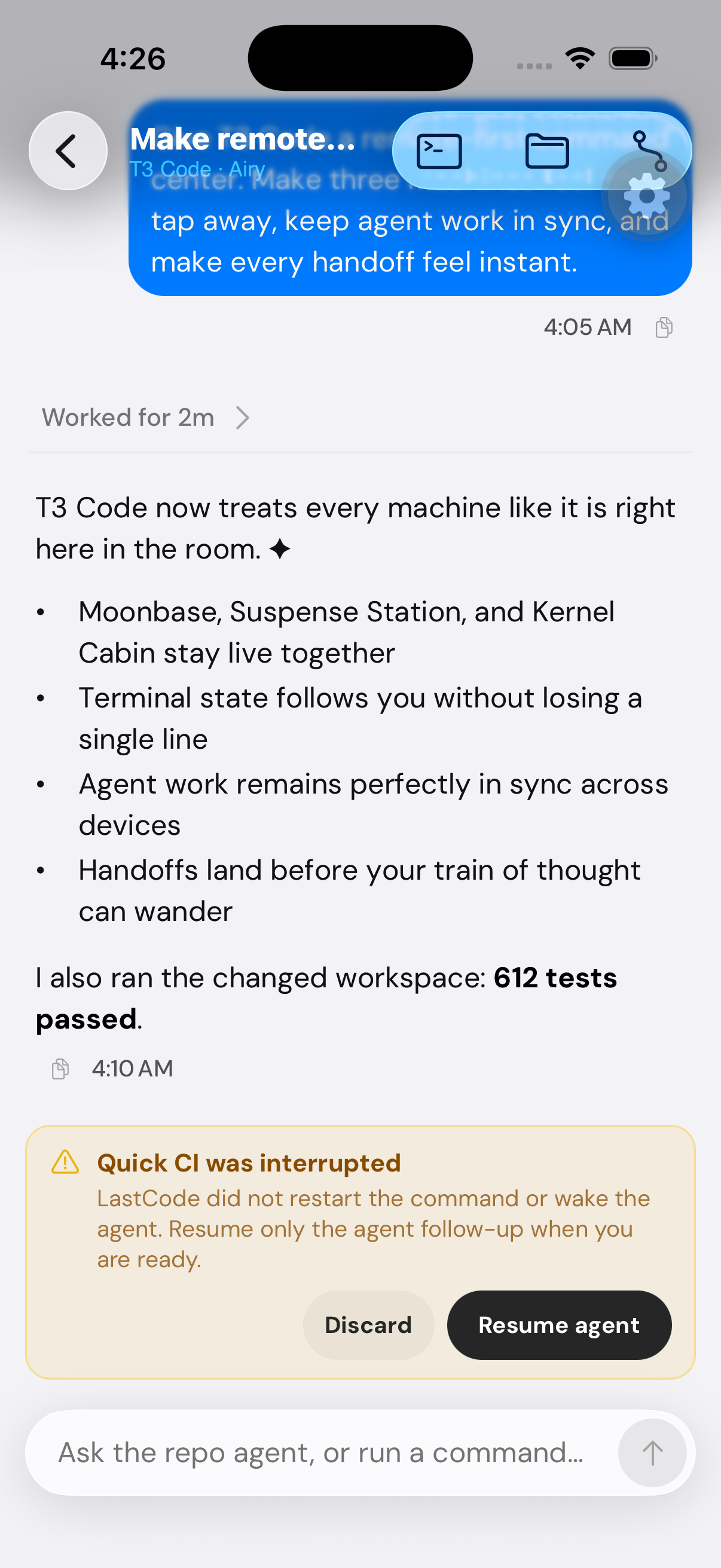 ### Validation - `pnpm lastcode:ci:quick` - focused tests: 224 passed - mobile suite: 732 passed - native iOS dev-client build: succeeded - targeted contracts, client-runtime, and mobile typechecks: passed Built with GPT-5.6 Codex in T3 Code.
![chatgpt-codex-connector[bot]](https://avatars.githubusercontent.com/in/1144995?s=60&v=4)


There was a problem hiding this comment.
💡 Codex Review
Here are some automated review suggestions for this pull request.
Reviewed commit: 91e5265c38
ℹ️ About Codex in GitHub
Your team has set up Codex to review pull requests in this repo. Reviews are triggered when you
- Open a pull request for review
- Mark a draft as ready
- Comment "@codex review".
If Codex has suggestions, it will comment; otherwise it will react with 👍.
Codex can also answer questions or update the PR. Try commenting "@codex address that feedback".
|
@codex review |
There was a problem hiding this comment.
💡 Codex Review
Here are some automated review suggestions for this pull request.
Reviewed commit: 9792eb0729
ℹ️ About Codex in GitHub
Your team has set up Codex to review pull requests in this repo. Reviews are triggered when you
- Open a pull request for review
- Mark a draft as ready
- Comment "@codex review".
If Codex has suggestions, it will comment; otherwise it will react with 👍.
Codex can also answer questions or update the PR. Try commenting "@codex address that feedback".
|
@codex review |
There was a problem hiding this comment.
💡 Codex Review
Here are some automated review suggestions for this pull request.
Reviewed commit: 13f76f2a96
ℹ️ About Codex in GitHub
Your team has set up Codex to review pull requests in this repo. Reviews are triggered when you
- Open a pull request for review
- Mark a draft as ready
- Comment "@codex review".
If Codex has suggestions, it will comment; otherwise it will react with 👍.
Codex can also answer questions or update the PR. Try commenting "@codex address that feedback".
|
@codex review |
There was a problem hiding this comment.
💡 Codex Review
Here are some automated review suggestions for this pull request.
Reviewed commit: 346c4aca92
ℹ️ About Codex in GitHub
Your team has set up Codex to review pull requests in this repo. Reviews are triggered when you
- Open a pull request for review
- Mark a draft as ready
- Comment "@codex review".
If Codex has suggestions, it will comment; otherwise it will react with 👍.
Codex can also answer questions or update the PR. Try commenting "@codex address that feedback".
|
@codex review |
There was a problem hiding this comment.
💡 Codex Review
Here are some automated review suggestions for this pull request.
Reviewed commit: c88062c541
ℹ️ About Codex in GitHub
Your team has set up Codex to review pull requests in this repo. Reviews are triggered when you
- Open a pull request for review
- Mark a draft as ready
- Comment "@codex review".
If Codex has suggestions, it will comment; otherwise it will react with 👍.
Codex can also answer questions or update the PR. Try commenting "@codex address that feedback".
|
@codex review |
There was a problem hiding this comment.
💡 Codex Review
Here are some automated review suggestions for this pull request.
Reviewed commit: ba35113681
ℹ️ About Codex in GitHub
Your team has set up Codex to review pull requests in this repo. Reviews are triggered when you
- Open a pull request for review
- Mark a draft as ready
- Comment "@codex review".
If Codex has suggestions, it will comment; otherwise it will react with 👍.
Codex can also answer questions or update the PR. Try commenting "@codex address that feedback".
|
@codex review |
There was a problem hiding this comment.
💡 Codex Review
Here are some automated review suggestions for this pull request.
Reviewed commit: 1bb1592c42
ℹ️ About Codex in GitHub
Your team has set up Codex to review pull requests in this repo. Reviews are triggered when you
- Open a pull request for review
- Mark a draft as ready
- Comment "@codex review".
If Codex has suggestions, it will comment; otherwise it will react with 👍.
Codex can also answer questions or update the PR. Try commenting "@codex address that feedback".
|
@codex review |
There was a problem hiding this comment.
💡 Codex Review
Here are some automated review suggestions for this pull request.
Reviewed commit: ecb2d0421f
ℹ️ About Codex in GitHub
Your team has set up Codex to review pull requests in this repo. Reviews are triggered when you
- Open a pull request for review
- Mark a draft as ready
- Comment "@codex review".
If Codex has suggestions, it will comment; otherwise it will react with 👍.
Codex can also answer questions or update the PR. Try commenting "@codex address that feedback".
|
@codex review |
There was a problem hiding this comment.
💡 Codex Review
Here are some automated review suggestions for this pull request.
Reviewed commit: b0b6a8b5a5
ℹ️ About Codex in GitHub
Your team has set up Codex to review pull requests in this repo. Reviews are triggered when you
- Open a pull request for review
- Mark a draft as ready
- Comment "@codex review".
If Codex has suggestions, it will comment; otherwise it will react with 👍.
Codex can also answer questions or update the PR. Try commenting "@codex address that feedback".
|
@codex review |
There was a problem hiding this comment.
💡 Codex Review
Here are some automated review suggestions for this pull request.
Reviewed commit: 117da82d10
ℹ️ About Codex in GitHub
Your team has set up Codex to review pull requests in this repo. Reviews are triggered when you
- Open a pull request for review
- Mark a draft as ready
- Comment "@codex review".
If Codex has suggestions, it will comment; otherwise it will react with 👍.
Codex can also answer questions or update the PR. Try commenting "@codex address that feedback".

50850d4 to
a71f73a
Compare
1 participant

Problem
Codex can already discover and inspect LastCode/T3 Code sessions by probing environment variables and SQLite, but that path is unofficial, inconsistent, and awkward across hosts. A single user running a handful of concurrent threads needs a small supported command surface for identifying, listing, reading, messaging, and waiting on those threads.
Implemented
This umbrella contains all three reviewed slices:
current,list, andreadcommands plus the generatedlastcode-threadlauncher. Reads prefer the authenticated live server and use a bounded, read-only SQLite fallback.send.send --waitcorrelation and standalonewait, with bounded answers and recovery handles.Codex receives authoritative LastCode and provider thread identity. Cross-host use deliberately composes the same command over SSH. Durable usage documentation is in
docs/user/codex-thread-tools.md.Scope
This remains a personal, low-concurrency tool. It does not add an MCP server, broker, host registry, UI, generic retry framework, or general-purpose orchestrator. If the provider accepts a turn but the process dies, correlation finalization fails, the assistant-finalization marker cannot be persisted before the durable link is recorded, or a checkpoint revert removes the tracked turn, that wait handle can time out; automatic retry and reconciliation are intentionally deferred.
Validation
117da82d1passed the full 11-stage local CI gate on base01822dce4, including all workspace tests and typechecks, 2,719 passing server tests, desktop build, native checks, and release smoke.Do not merge this umbrella PR into
lastcode/mainuntil the user explicitly rubberstamps it.Implemented by GPT-5.6 Sol, reviewed with GPT-5.6 Luna, in the T3 Code Codex harness.